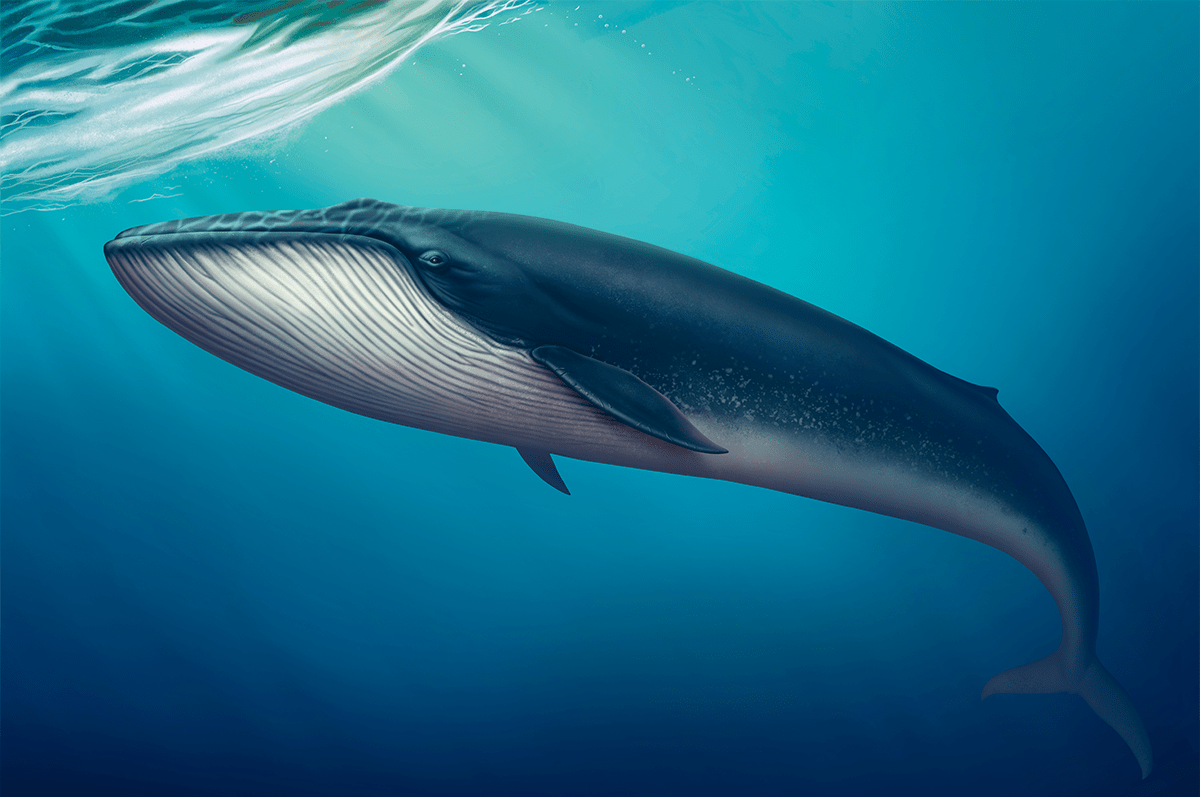
When they’re alive, whales comprise huge chunks of biomass that move thousands of miles through the world’s oceans. When they’re dead, their impressive biomass sinks to the ocean floor and provides a veritable feast for other ocean organisms. A recent study in Frontiers in Marine Science offers a deep perspective on these so-called whale falls.
In 2009, a carcass from either a blue whale or fin whale was discovered in images from a remotely operated vehicle (ROV) 4,226 feet down on the Cascadia Continental Margin, off the coast of Vancouver Island. The carcass sits relatively close to a known methane seep that causes low-oxygen (hypoxic) ocean conditions.
The study authors compared the whale carcass, dubbed the “Clayoquot whale fall,” from multiple ROV images spanning about 15 years. With state-of-the-art visual analyses, they assessed the amount of decay, the microbial colonization of the carcass, and the surrounding community of organisms. Four 16x16-inch plastic plates that were anchored on the sea floor adjacent to the whale fall allowed for precise calculations of the whale’s dimensions.
Read more: “Humans Are Overzealous Whale Morticians”
The results showed little change in the carcass over the 15-year period. Its skull and skeleton remained intact, even while the bacterial mats increasingly covered the bone surfaces. The slow decay of the carcass supports the “oil-gradient hypothesis” that the high lipid content of whale bones deters bone erosion. “At the rates of bone decomposition we measured over 11 years,” wrote the study authors, “we postulate that the cranium and vertebrae will persist for at least another decade.”
Within three feet of the whale fall, the researchers noted 31 species of organisms—from mollusks to deep ocean clams, mussels, gastropods, and worms. By 2023, the carcass was well into the last stage of decay, or the “sulphophilic stage.” Scavenging fishes had long ago devoured all the soft tissues; worms and mollusks had consumed any leftover blubber; and bacteria had taken over.
Bacteria break down fats from whale bones, releasing sulfur, which attracts more bacteria and other sulfur-loving organisms. The study authors concluded that “the Clayoquot whale fall sulphophilic stage, supporting bacterial mats, vesicomyid clams, and a significant number (about 33) of siboglinid tubeworms, had lasted more than 21 years,” and still wasn’t over yet.
Now, that’s a whale-scaled version of a Sunday buffet. 
Enjoying Nautilus? Subscribe to our free newsletter.
Lead image: Konstantin Gerasimov / Adobe Stock