She’s known as the “Mother of Hubble” to many of those at NASA who worked with her in the 20th century. Nancy Grace Roman was not only a pioneering astronomer who helped humanity understand the types and motions of the countless stars that dot our universe. She was also the first female executive at NASA, where she served as Chief of Astronomy in the 1960s and ’70s.
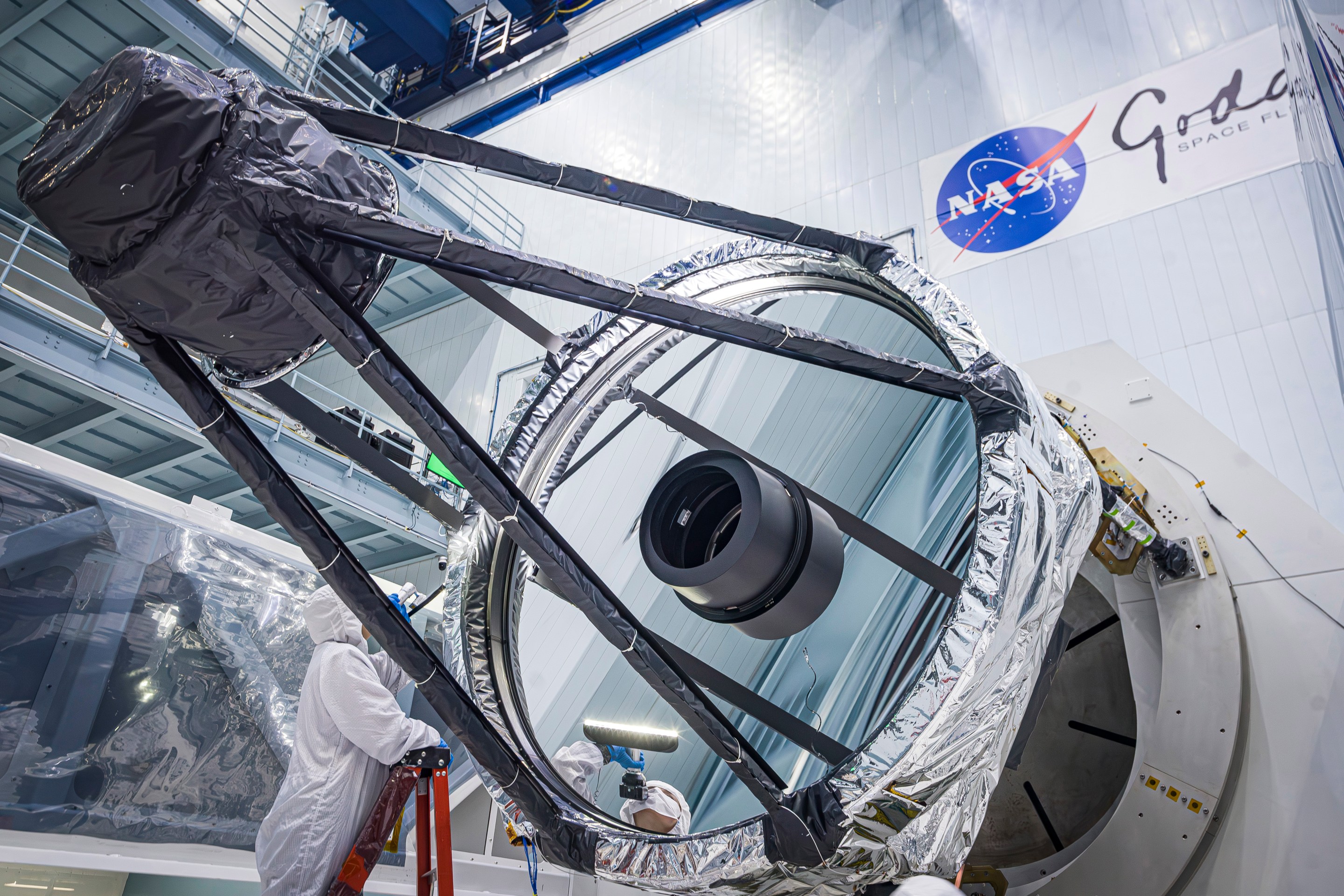
And now, after seminal contributions to planning the Hubble Space Telescope, which still delivers eyepopping insight into the cosmos, Roman is being immortalized in the naming of Hubble’s successor, the Nancy Grace Roman Space Telescope. The new, $4 billion NASA space telescope is slated to launch as early as September, and the federal space agency announced this week that the instrument was being moved to the Kennedy Space Center in Florida to prepare it for liftoff.
The telescope is packed with cutting-edge technology that promises to capture deep, panoramic images of the universe that will accelerate observation and study of mysterious phenomena and as-yet unseen wonders. According to NASA the instrument will have a field of view at least 100 times larger than Hubble’s and will have the ability to block starlight, allowing it to peer directly into the unexplored corners of our galaxy at planet-forming disks and exoplanets.
But who was Nancy Grace Roman?
Read more: “The Woman Behind the World’s Biggest Camera”
Born in 1925 to a music teacher mother and a geophysicist father, Roman seemed primed for a scientific life. Indeed, she apparently decided by middle school that she would devote her career to astronomy. As a Swarthmore College student in the early 1940s, Roman had to overcome many of the unfortunately typical obstacles standing in the way of women pursuing a scientific career in that era. But she did. And in 1946, after getting some experience working with telescope technology, she began a graduate degree at the University of Chicago.
Showing her astronomical prowess there (and yes, overcoming more sexist obstacles and attitudes), Roman got her Ph.D. and went on to study stellar composition and motion at the most advanced observatories of the day: Yerkes in Wisconsin, McDonald in Texas, and the David Dunlap in Toronto. Her research at the Yerkes Observatory in particular resulted in some of the most highly-cited scientific papers of 1950.
Established as an astronomy expert, Roman started learning the emerging field of radio astronomy in the 1950s, first at the Naval Research Laboratory, then at NASA, where she started in 1959. At the federal space agency, she quickly climbed the ranks, becoming the first Chief of Astronomy in NASA's Office of Space Science.
Her scientific and administrative career at NASA gave birth to several astronomical satellites that explored cosmic X-rays and gamma-rays and experiments on many of the space age’s exploratory mission programs, including Gemini and Apollo. This work culminated in Roman leading the development of NASA’s airborne astronomy program, which started with telescopes mounted to jets, maturing to space telescopes like Hubble, and now the telescope that bears her name.
As we watch the Nancy Grace Roman space telescope launch into the sky this autumn and process the astounding images it will gather for humanity, we remember the strides she made, not only in astronomy (97 publications worth!), but for women in science more broadly. 
Enjoying Nautilus? Subscribe to our free newsletter.
Lead image: NASA/ESA