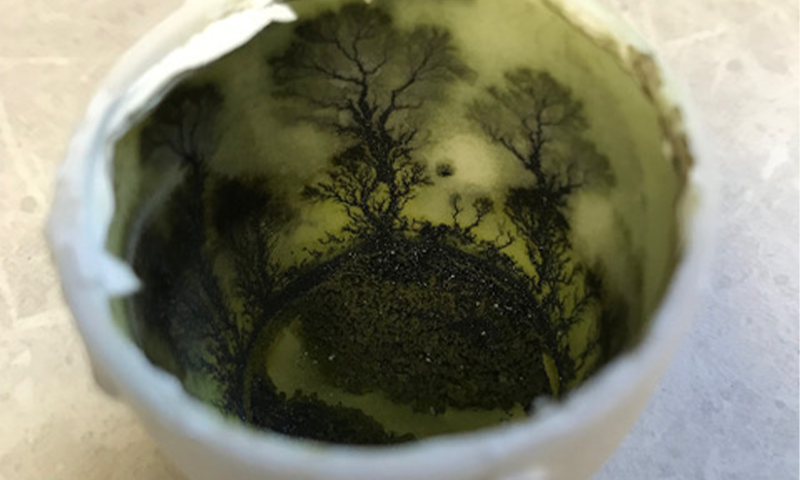
When chemist Robert Hamers cracked open the crucible he had used to heat a brew of metal crystals, he was greeted with a surprise: an enchanted forest in deep shades of green. The cobalt-containing crystals he had been growing for two weeks in an oven had vined their way upward from the base in a stunningly familiar pattern and shade to match.
“I was completely awestruck,” says the chemistry professor at University of Wisconsin–Madison. It looked as if tiny elm trees, surrounded by shrubs and hedges, had been skillfully drawn inside the egg-shaped cup. “What really amazed me was, you look at it and you see a trunk is growing down from the bottom, and there's branches, and they are pretty well resolved, and there's kind of this little fuzz, where the leaves would be.”
Hamers had set out to grow “a very large” crystal of lithium cobalt dioxide, the material used in the batteries powering mobile phones, laptops, video cameras, and other gadgets. He planned to use it to develop a fingerprint of the chemical in nature, through a technique known as Fourier-transform infrared spectroscopy. Once developed, the fingerprint could be used to scan landfill sites and other environments for the leaked chemical from discarded batteries, tracing the chemical to its end of life, Hamers says.
There was a long lead up time to cracking open the sealed crucible. First, a few bits of lithium cobalt oxide were speckled inside, an ink-black powder to the naked eye. These small crystals are the seed from which the larger crystal can grow, building on the lattice structure that grows in the presence of lithium salts. Extremely high temperatures are required—reaching beyond 1,292 degrees Fahrenheit—which the crucible can withstand inside a special furnace. Then the cooling begins: Larger crystals only form if the cooling period is extremely slow—in this case the scientists gave it two weeks.
Ultimately, the experiment failed: The crystals that grew inside the crucible weren’t big enough for the tests Hamers wanted to do. But his enchanting photo of the result won one of the awards of the university’s annual Cool Science Image Contest. Even failure can carry a whiff of magic. 
Lead photo by Robert Hamers