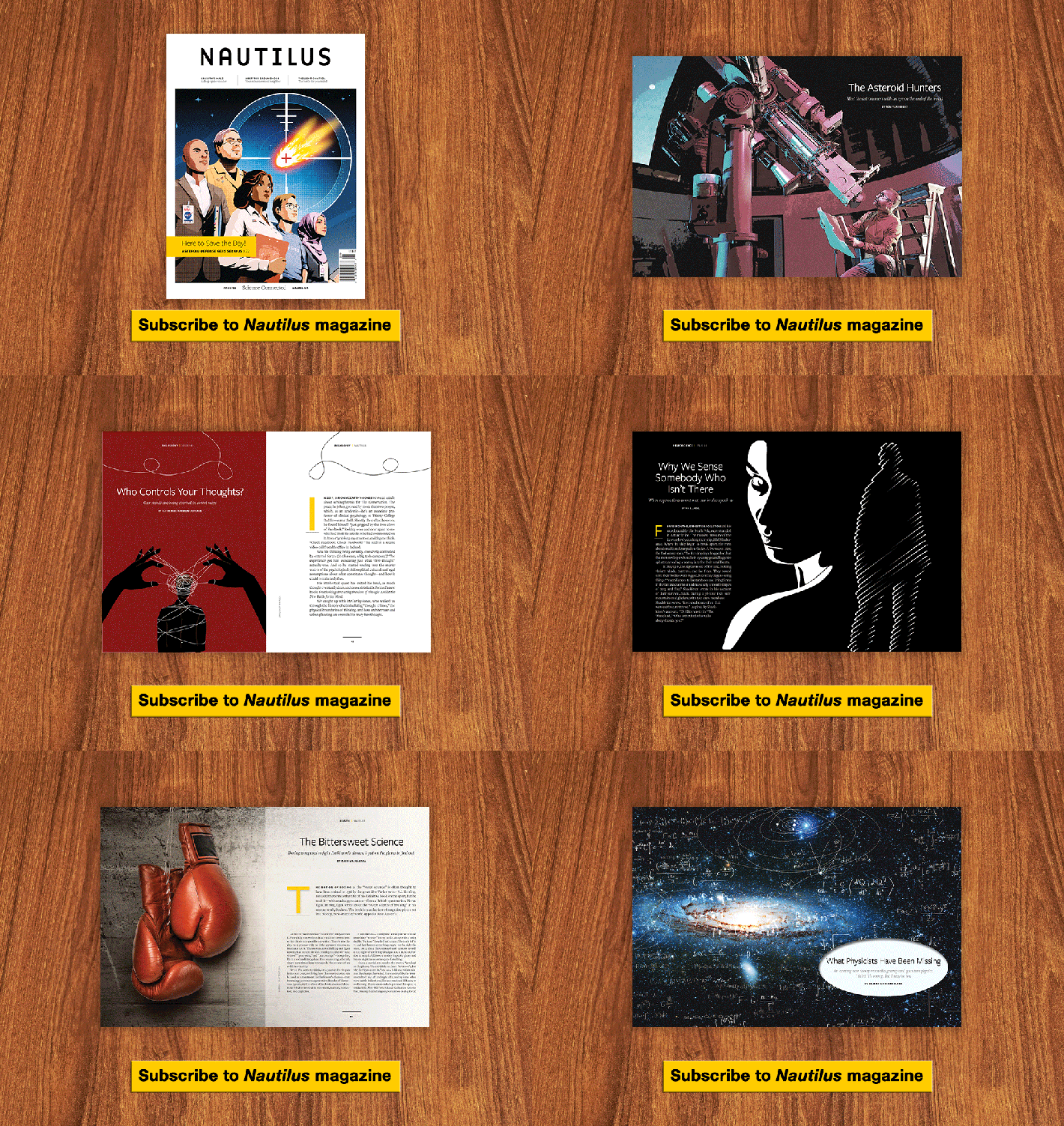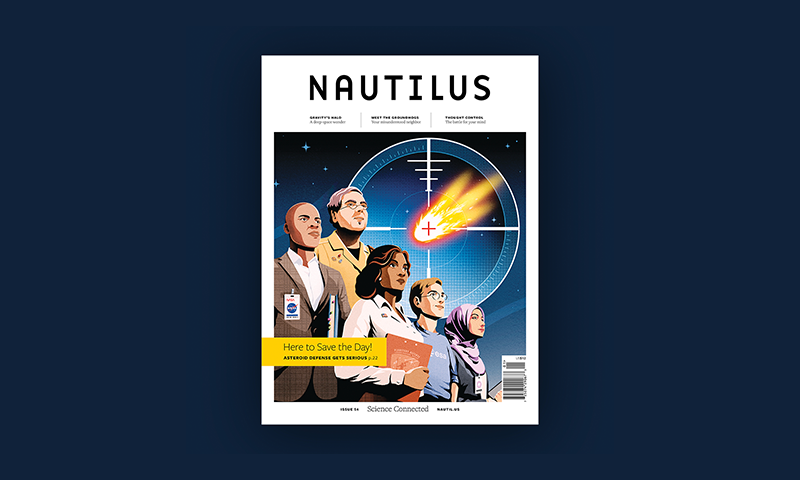
Science elucidates the ways of nature. And those ways are marvelous and strange and surprising. Spooky, too. Although “spooky” may not be the right word for the annihilation of Earth. In our cover story, “Here to Save the Day,” Christian Köberl, a professor of planetary geology, explains that Earth is “in the middle of a cosmic shooting gallery.” That could be a tagline for movies like Deep Impact, and “Here to Save the Day” has plenty of drama. But it’s time to take back the image of asteroids from Hollywood.
That’s exactly what writer Tom Vanderbilt does. You will read what the world’s top astronomers say about the likelihood of an asteroid crashing into us and learn what scientists and nations are doing to prevent it. I’m not saying you will come away from Tom’s absorbing article breathing a sigh of relief. But you will get the uplifting clarity that comes when science clears away myth and misinformation. Science doesn’t have the final word on nature. But it does help you make peace with uncertainty.
The strange and surprising? That’s here, too. You will learn why your brain generates hallucinations when its expectations aren’t met. And you will encounter a new gravity theory that challenges Einstein. You will read a story about sperm that is so weird because A) Who in the world writes a whole article about sperm? B) Each tiny sperm has a will of its own in the battle for insemination. It must be cooperative one moment and competitive the next. Sperm, they gotta be smart.
And the marvelous? That’s Susan and Joe Sam, an elderly couple in Michigan for whom every day is Groundhog Day. For the past 20 years, Susan and Joe have been watching the groundhogs in their backyard. They aren’t scientists, but scientists who study groundhogs have learned plenty from Susan and Joe. You can’t read Brandon Keim’s article, “The Groundhog Watchers,” and see groundhogs as pests, even if they do treat themselves to a few tomatoes in your garden.
There’s a school of thought that science journalism should stick to the facts. It’s no place to write about personal experiences, set a scene, portray characters. I disagree, and submit as evidence, “The Bittersweet Science.”
Author Mark MacNamara, who has Parkinson’s disease, puts on the gloves to find out whether “Rock Steady Boxing,” reputed to knock down Parkinson’s symptoms, is worth the fight. Mark’s personal experiences hold truths for everyone. Kimball Magoni, a clinical psychologist who also has Parkinson’s, tells Mark that camaraderie is the best medicine. Places like Rock Steady Boxing bring people who feel isolated back into the tribe. They help them build self-acceptance. When that happens for people with Parkinson’s, Magoni says, “then you don’t care what somebody at the next table in the restaurant thinks of your tremors.”
Mark’s article is the definition of how a disease doesn’t define a person. It’s not Mark MacNamara, the Parkinson’s victim, that you meet in the article, it’s Mark MacNamara, the journalist. Word for word, sentence for sentence, “The Bittersweet Science” is woven with acuity, compassion, poetry, and humor. That’s rare in journalism. And precisely why Nautilus publishes stories like “The Bittersweet Science.”