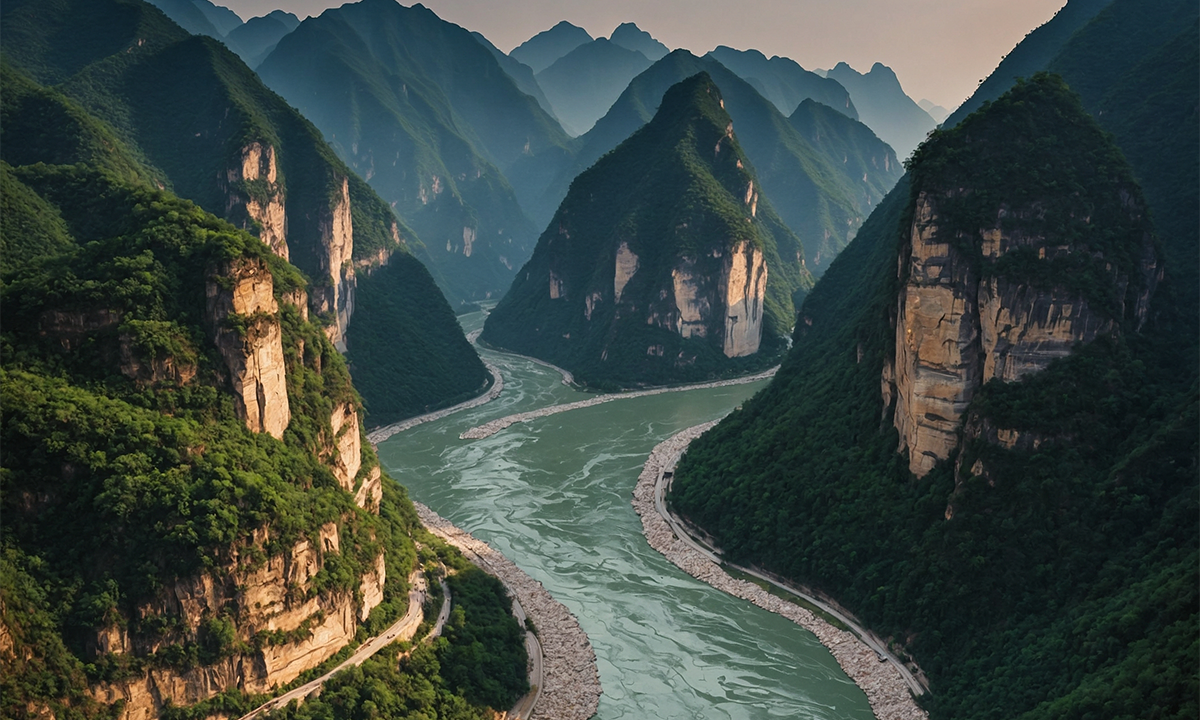
As former wild rivers have been increasingly developed for industry and commerce, water and habitat quality have eroded, leading to a cascade of effects on flora and fauna. Some changes to river ecosystems, however, can be ameliorated through dramatic conservation measures. A recent study published in Science reported positive effects of a sweeping 10-year commercial fishing ban on the Yangtze River in China.
The ecological decline in the Yangtze River began in the 1950s, as economic development scaled up. “Over the past four decades, China has emerged as the world’s second-largest economy, yet the costs of this achievement are reflected in marked ecological and environmental degradation,” wrote the study authors.
Yangtze River species, including the river dolphin and Chinese paddlefish, were driven to extinction, while the fisheries industry collapsed.
Read more: “The Ancient Paths of an Iconic River”
In 2021, in a bold attempt to restore the ailing fisheries, China enacted a strict 10-year ban on fishing across the entire Yangtze basin. The ban was accompanied by strict enforcement measures, as well as ecosystem protections ranging from limiting sand mining to reducing agricultural runoff and ensuring sufficient water flow from dams. More than 100,000 fishing boats were recalled from the Yangtze.
In the recent study, researchers from China, France, the United States, and Canada evaluated Yangtze fish communities before and after the start of the fishing ban. They used regular monitoring data to compare fish species richness, biomass, body condition, and diversity from 2018 (pre-ban) to 2023 (ban in place).
The results showed that fish biomass had doubled, especially through increases in some of the larger-bodied species. Both large and small species showed improvements in body condition. And while endangered species, such as the Yangtze sturgeon (Acipenser dabryanus) and tube fish (Acipenser dabryanus), remained rare, they showed preliminary population recovery. The population of Yangtze finless porpoises (Neophocaena asiaeorientalis), which rely on fish prey, increased by a third.
According to the study’s official press release, “The comprehensive fishing ban implemented under the Yangtze River Protection Law has effectively halted seven decades of biodiversity decline.”
The ban, however, required ambitious political decisions and regulatory enforcement that may be hard to sustain in the Yangtze or other large river basins. The jury is still out on what people are willing to give up in the short-term to foster the long-term ecological health of rivers. 
Enjoying Nautilus? Subscribe to our free newsletter.
Lead image: loves st / Shutterstock