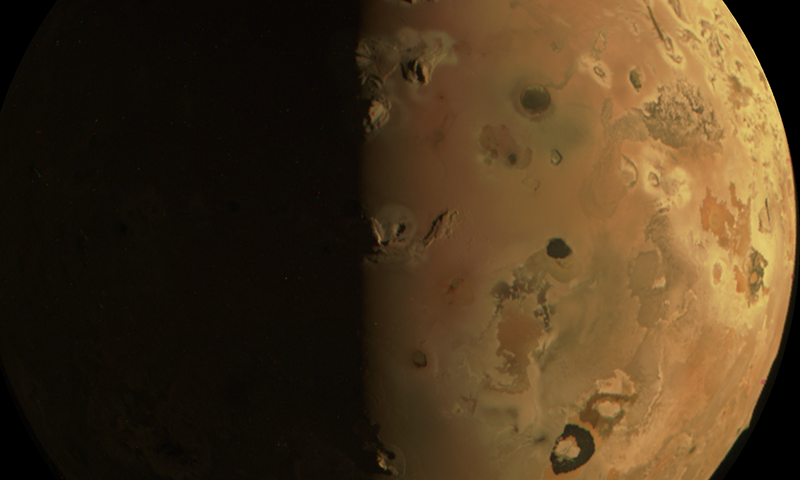
Across the surface of the otherwise-freezing moon, hundreds of volcanoes spew molten lava dozens of miles up, into a thin sulfurous atmosphere. This is the dramatic life of Io, Jupiter’s closest moon. Its ever-changing surface was captured in stunning new high-resolution images on a recent flyby of NASA’s space probe Juno.
Humans have known about Io’s existence for more than four centuries (though the first person to detect it remains a point of debate—was it Italian polymath Galileo Galilei on January 8 in 1610 or German astronomer Simon Marius on December 29 in 1609?). But only in the past four-and-a-half decades has its vivacious nature come into focus.
In March 1979, Voyager 1 sailed past the moon’s surface for the first time and captured images of its unusual surface. It was covered with pits, but they were not impact craters as on our own moon. It was also studded with mountains soaring beyond 57,000 feet tall (dwarfing our 29,000-foot Everest). By that June researchers had announced they’d spotted two distinct plumes coming from Io’s peaks—the first discovery of volcanoes beyond Earth.
The cause of Io’s volcanism and inner heat is now suspected to be powerful gravitational squishing: As it gets pulled in an oblong orbit close to the massive Jupiter—it is also pulled periodically by its Galilean sister moons orbiting slightly farther out, Europa, Ganymede, and Callisto. This dynamic creates immense amounts of friction, which generates “tidal heating” within the planet that, in turn, likely fuels a subsurface ocean composed, in part, of liquid magma.
Juno will make another pass of the dynamic moon on February 3, soaring about 930 miles above its surface—safely out of reach of its 62-mile-high volcanic plumes—before returning to a more distant orbit to study other dynamics of the strange Jovian system. 
Lead image courtesy of NASA / SwRI / MSSS