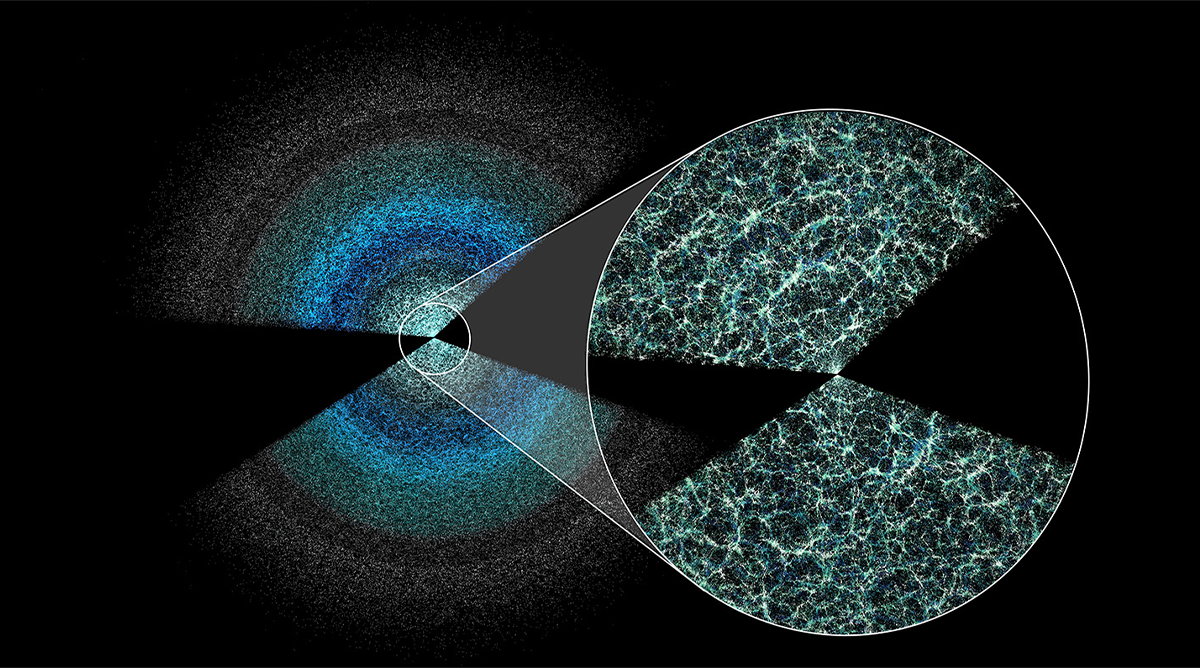
For the past five years, 5,000 robotic fiber-optic eyes housed in a mountaintop observatory have been tirelessly scanning the night sky. They belong to the Dark Energy Spectroscopic Instrument (or DESI), and three nights ago, they finally finished their mission to create the biggest, most detailed 3-D map of the universe ever conceived.
Spanning a staggering 11 billion years of cosmic history, DESI’s map contains data for “six times as many galaxies and quasars as all previous measurements combined.” The expansive map will help researchers investigate the effects of dark energy—the mysterious theoretical substance that makes up around 70 percent of our universe and is thought to be the driving force behind its expansion.
“The Dark Energy Spectroscopic Instrument has truly exceeded all expectations, delivering an unprecedented 3-D map of the universe that will revolutionize our understanding of dark energy,” Kathy Turner of the Department of Energy said in a statement. “From its inception, we envisioned a project that would push the boundaries of cosmology, and to see it come to such a spectacularly successful completion for its initial survey, ahead of schedule and with such rich data, is incredibly rewarding.”
Read more: “How to Measure the Universe”
DESI’s preliminary findings have already made waves in astrophysics. Analysis of data from just a few years of observations revealed that the accelerating force of dark energy—long thought to be a constant—could be weakening. And astronomers are eager to get started delving into the new troves of data DESI’s collected.
“We’re going to celebrate completion of the original survey and then get started on the work of churning through the data,” DESI director Michael Levi said. “Because we’re all curious about what new surprises are waiting for us.”
We’ll have to wait for those surprises—the first analyses of DESI’s massive dataset aren’t expected until 2027. In the meantime, DESI is continuing with observations. By 2028 the team plans to expand DESI’s map from 14,000 square degrees to 17,000 square degrees—over 40 percent of the sky.
Not bad for a lonely robot on a mountain, staring up at the stars. 
Enjoying Nautilus? Subscribe to our free newsletter.
Lead image: Claire Lamman/DESI collaboration