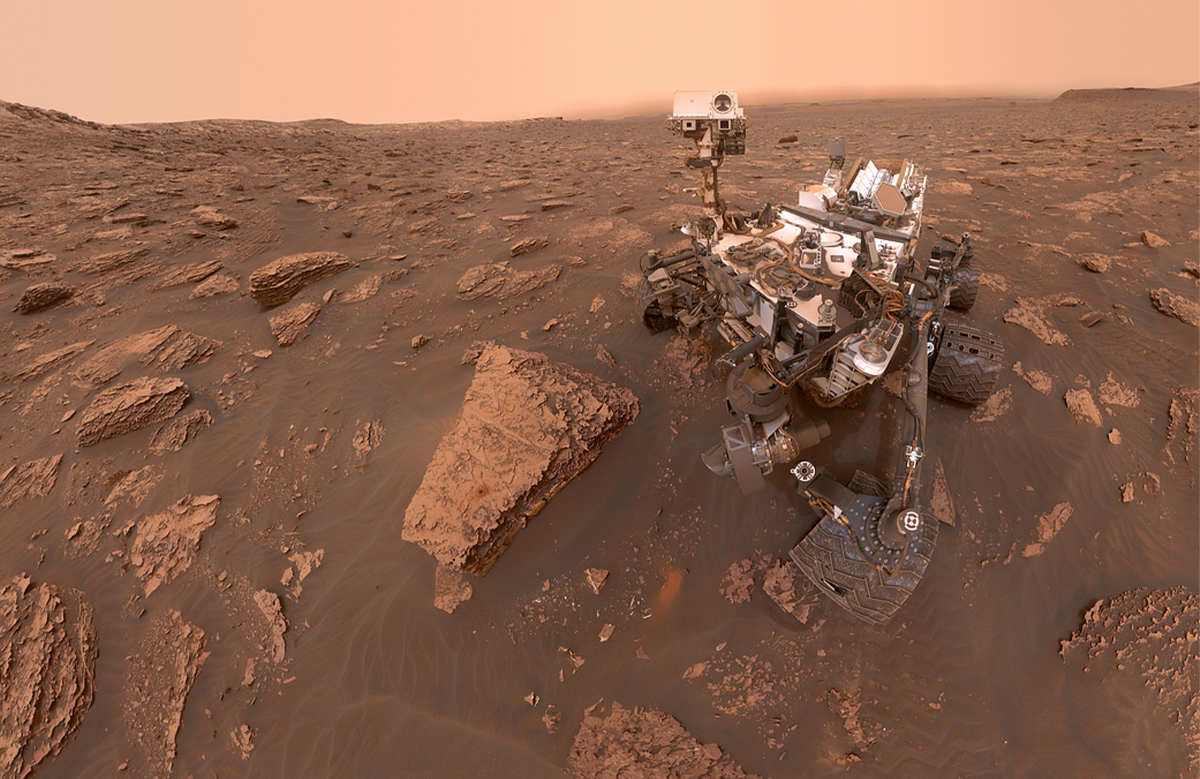
With all the excitement over sending scientists back to the moon, it’s easy to forget we’ve already got a pair of talented chemists on Mars: the Curiosity and Perseverance rovers. Although they beam back plenty of breathtaking images, these two robots are more than just cameras on wheels. Their primary mission is to search for signs of ancient life, and they’re equipped with a suite of onboard scientific instruments and chemical reagents to carry that mission out.
Now, new research published in Nature Communications details Curiosity’s latest find—never-before-seen organic compounds, including one with a structure similar to DNA precursors.
“We think we’re looking at organic matter that’s been preserved on Mars for 3.5 billion years,” study author and NASA geologist Amy Williams of the University of Florida said in a statement. “It’s really useful to have evidence that ancient organic matter is preserved, because that is a way to assess the habitability of an environment. And if we want to search for evidence of life in the form of preserved organic carbon, this demonstrates it’s possible.”
Read more: “Bringing Mars Rocks to Earth”
Curiosity extracted samples from clay deposits from Gale crater, broke them down with on-board chemicals, and analyzed them with gas chromatography–mass spectrometry. Together with its earthbound team, the rover found more than 20 organic molecules, including some surprising large compounds. One was a nitrogen-bearing molecule with a structure similar to DNA precursors and another was a benzothiophene, a double-ringed organic molecule containing sulfur, likely brought to the planet via meteorite.
“The same stuff that rained down on Mars from meteorites is what rained down on Earth, and it probably provided the building blocks for life as we know it on our planet,” Williams said.
To help interpret Curiosity’s data, scientists back on Earth performed similar experiments on a 7-billion-year-old meteorite retrieved from Australia in 1969. They even simulated the effects of a leak that occurred shortly after the rover landed (the mishap hasn’t interfered with Curiosity’s analyses, and may have even helped out).
“We now know that there are big complex organics preserved in the shallow subsurface of Mars, and that holds a lot of promise for preserving large complex organics that might be diagnostic of life,” Williams said.
These encouraging findings come as the European Space Agency plans to launch its own Mars rover in 2028. Named for Rosalind Franklin, the chemist who helped determine the double helix structure of DNA, this planned rover will bring even more scientific instrumentation to the red planet and join her colleagues Curiosity and Perseverance in their quest for signs of ancient life. 
Enjoying Nautilus? Subscribe to our free newsletter.
Lead image: NASA/JPL-Caltech/MSSS