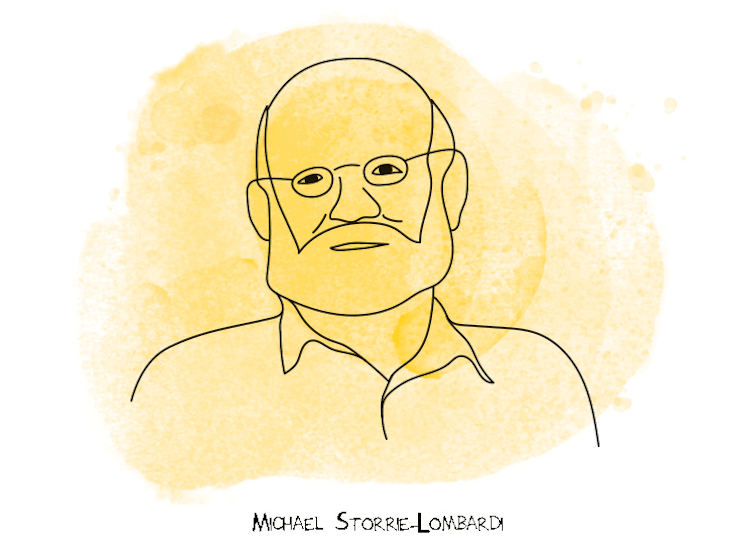
Being a scientist can be like willingly entering into a Roman gladiatorial contest. The hours are long, there’s a rank smell of indentured servitude, and at any minute your colleagues may attempt to eviscerate you for the pleasure of the crowds.
A lot of the time we can look beyond these challenges because we have an innate need to explore our curiosity. Or perhaps (shockingly) because we feel that a life spent in pursuit of knowledge is still a noble and useful thing. At other times I suspect we only stick around because we’re playing the real-world equivalent of a video game—conditioned to crave the chemical release from a momentary discovery, or a satisfactory fitting of a curve to data points. Yes, really, that can do it for you.
I’ve been awfully lucky in my career to be exposed to many extraordinary thinkers and many situations that have been truly mind-expanding. But if I’m honest, the instances of pure unbridled joy in science have been thinly scattered, and most of them I can point to as being the result of just a few people. Some of those best moments are because of one person in particular—the scientist Michael Storrie-Lombardi.
Michael’s a marvel, a maverick, and a catalyst. He’s also a physicist who’s an M.D., as well as an early computer entrepreneur, and in my view one of the first modern astrobiologists. I met Michael when I was a graduate student at the University of Cambridge’s Institute of Astronomy and Michael was gleefully chasing his tiny son across the floor of the morning coffee room. My first thought was, “Who the hell is this guy?”
I soon got to watch Michael working his magic on others. That magic included firing up a whole research effort on classifying galaxies using artificial neural networks. This was the 1990s, so many, many years before Big Data or Deep Learning became buzzwords. It was innovative, heady stuff.
Be like Michael Storrie-Lombardi; get excited by ideas and observations and hang onto that thread for dear life.
To my astronomy-riddled graduate brain, Michael was a beacon to a promised land of scientific wonders without borders. Conversations might start with the then-fresh challenges of the Human Genome project, and end up with an idea for a self-sequencing DNA system where genetically engineered ribosomes would emit photons according to the nucleotides they were sliding over. Or we’d talk about the information content of non-linear chemical oscillators, only to end the night coding up a simulation to settle some esoteric argument. Lunacy? Probably, but so much fun because it was science for sheer pleasure—guilt free, worry free.
For a while in the 1990s and early 2000s Michael worked at NASA’s Jet Propulsion Laboratory, once again playing the role of scientific instigator and catalyst. But JPL couldn’t quite contain him. One day I gave a call to see how things were doing. “Okay,” he said, “but you know I’ve started a new institute?” I did a double-take and asked where it was based. “Oh, in my basement,” came the calm reply. “I’m getting the servers set up this week, before I go to Antarctica to look for microbes.”
This was a potent lesson for me. What do you do when you’re dissatisfied and need to make better use of your resources? Many of us in science suffer the slings and arrows very ungraciously. But what I learned from Michael was that we really are masters of our own domain—there is nothing truly stopping us from applying an entrepreneurial spirit, getting non-profit status, and carrying right on doing the important stuff.
It’s a mindset that’s stuck with me. A year ago I spent a crazy six months shuttling between New York and Tokyo in order to work with a remarkable new group exploring the science of the origins of life. I thought it was a mad stretch from my astronomical background, but I also knew I couldn’t resist, and it led to an unexpected and fresh insight—a proposal for quantifying the relationship between planets and their potential for initiating life. That research now sits proudly in a peer-reviewed journal for all to argue over. I’m pretty sure I did all of this because of those early inspirations.
To this date Michael and I have only ever managed to really write one research paper together, and that paper struggled with peer review because, big surprise, it didn’t really fit any preset slot in the scientific landscape. It was based on an observation (by Michael) that the element phosphorus, that is so absolutely critical for terrestrial biochemistry, is also shockingly under-abundant compared to other biologically critical elements (carbon, hydrogen, oxygen, nitrogen) in the solar system. This suggested that phosphorus could be a “bottleneck” element for life in the cosmos.
It was a good paper, and because it was written with Michael it was fun. Over time I’ve also realized that the science of that work makes for a pretty good allegorical tale. Plain old phosphorus is terribly important for life, but it can be in short supply. Equally, some of the most essential elements for science are passion and delight at the sheer, absurd wonder of it all. These can also be in seriously short supply.
What’s the trick for getting through the bottleneck? Be like Michael Storrie-Lombardi; get excited by ideas and observations and hang onto that thread for dear life. That, to me, is truly inspiring.
Caleb Scharf is an astrophysicist, the director of astrobiology at Columbia University in New York, and a founder of YHouse (yhousenyc.org), an institute that studies human and machine consciousness. His latest book is The Copernicus Complex: Our Cosmic Significance in a Universe of Planets and Probabilities.
Watch: Max Tegmark explains what we should make of the fact that the universe can be described in a few numbers.
A version of this article was originally published in our “Heroes” issue in December, 2016.