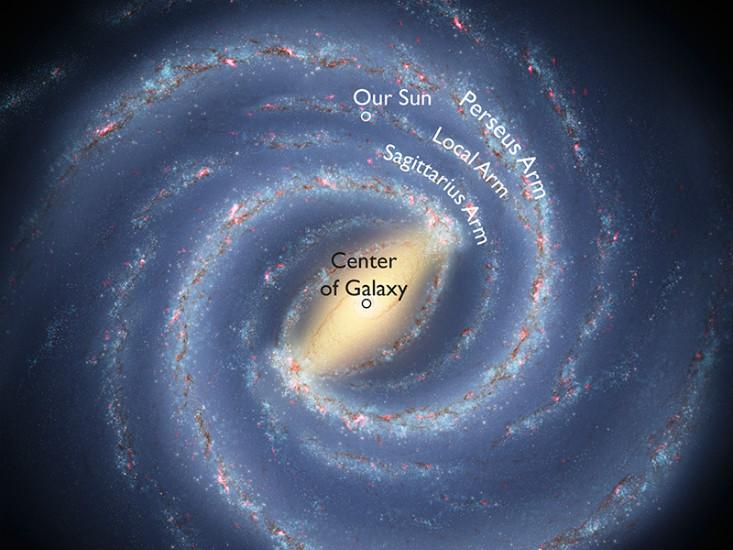
To solve a mystery, scientists often zoom in on it as close as they can, break the puzzling system down to its components, and analyze it piece by piece. Sometimes, comprehending a system requires just the opposite: pulling back to see the bigger picture. Sometimes that bigger picture is bigger than our galaxy, in which case, pulling back requires some clever investigation.
In the 1780s, William Herschel, an astronomer who had recently discovered Uranus, turned his telescope on the Milky Way, trying to figure out the shape of the group of stars that we see. There was an obvious bright stripe across the sky with a very high concentration, which seemed to be the same in a flat circle around us. He concluded, sensibly, that we were in the middle of a group of stars shaped like a “grindstone.” (If you’re more of a low-carb eater, think of a wheel of cheese.)
The mission of finding out more about the shape of the Milky Way was then stymied. Herschel could only see nearby stars using the visible part of the spectrum; he didn’t know that the light from very distant stars was being absorbed by the interstellar dust in between. “To a person tied to a tree in a foggy forest, it looks like the forest stretches equally away in all directions, wherever one is,” in the words of astronomer Laurence Marschall. How could we see the shape of the absolutely enormous thing that we’re sitting in? Wouldn’t that require zooming away in a spaceship and taking a look back at the whole thing?
Fortunately, no. Over a century later, Harlow Shapley used some state-of-the-art techniques to measure the distance to many groups of stars throughout the Milky Way. He pegged the size of the galaxy at around 100,000 light-years across, and saw from the measurements in different directions that we were not actually in the middle of the grindstone. Soon after, astronomers found an even better way to study the galaxy: by looking at the signature radio waves from hydrogen, which fly right through the fog of interstellar dust. By looking at the amount of and distance to hydrogen throughout the galaxy, astronomers could build a much more detailed map of it. Lo and behold, they found it was a barred spiral galaxy, like many beautiful examples we see out in the universe, rather than a cheese wheel, as appetizing as it may sound. In decades hence, scientists developed ever better methods that allowed them to “trace out the spiral arms very nicely, much like in other galaxies,” writes astronomer Kevin Jiang.
Still, using this indirect approach is hard, and we’re still refining it. Earlier this month, a new study from the the Very Long Baseline Array—a group of radio observatories spread over 5,000 miles from Hawaii to the U.S. Virgin Islands—argued for a change in the galactic maps. Specifically, researchers declared that the small spiral arm that includes us is more likely to be a branch off the giant Perseus Arm rather than off the mid-size Sagittarius Arm.
But don’t go and get that new-map-of-the-galaxy tattoo just yet: This research is at the edge of our understanding, and just as and the descriptions have changed before, new evidence may later push us right back to the Sagittarius Arm. In fact, there’s still some debate about whether galaxy should be said to have two arms or four. Until we can blast off to 100,000 light-years away and look back at our spiral galaxy, this incremental progress is probably the best we can hope for. The uncertainty that comes with being too close to a mystery is a formidable challenge.
Amos Zeeberg is the digital editor of Nautilus and oversees Facts So Romantic. Find him on Twitter @settostun.