Civilizations rise and fall. The Maya civilization once stretched over tens of thousands of miles in Central America, and during its golden age—known as the Classic Period, which lasted more than 600 years—it was admired for its grand limestone cities, advanced commerce, and its rich cultures of writing and art.
But the collection of linked city-states began to collapse at the end of the ninth century. For decades, historians and archaeologists have theorized that severe weather, and related famines, might have played a part. Now, scientists are finding confirmation in cave stalagmites, the ghostly rock spires that rise from the floor of some caverns due to the precipitation of calcium carbonate from the ceiling above. These stalagmites suggest that the empire’s undoing was indeed sown by a series of brutal droughts, including one that lasted 13 years.
“This period in Maya history has been a cause of fascination for centuries,” University of Cambridge paleoecologist Daniel H. James said in a statement. “There have been multiple theories as to what caused the collapse, such as changing trade routes, war, or severe drought, based on the archaeological evidence the Maya left behind,” said James, who conducted the research while a Ph.D. student at Cambridge’s Department of Earth Sciences.
James and his colleagues found the stalagmites in a cave in the Yucatán peninsula, in southern Mexico, and measured the oxygen isotopes they contained. These chemical fingerprints helped them to determine rainfall conditions for individual wet and dry seasons during a period known as the Terminal Classic, when Maya culture was unraveling, its limestone cities abandoned and its cultural forces draining out.
The empire’s undoing was indeed sown by a series of brutal droughts.
The data the scientists collected suggest that the region suffered eight wet season droughts that lasted at least three years, with the longest drought stretching more than a dozen years. (For comparison, the Dust Bowl drought that plagued the Central Plains of the United States in the 1930s and coincided with the Great Depression, lasted a decade.) The results were reported in the journal Science Advances.
Earlier research into the severity of droughts had looked at the oxygen isotopes found in lake beds, but this kind of data does not provide enough information to assess conditions within a given year. “Lake sediment is great when you want to look at the big picture, but stalagmites allow us to access the fine-grained detail that we’ve been missing,” said James, who is now a postdoctoral researcher at University College London.
The next step in piecing together the story of the Classic Maya civilization's disintegration: more spelunking to explore further caves for alluring stalagmites and the clues they may hold. 
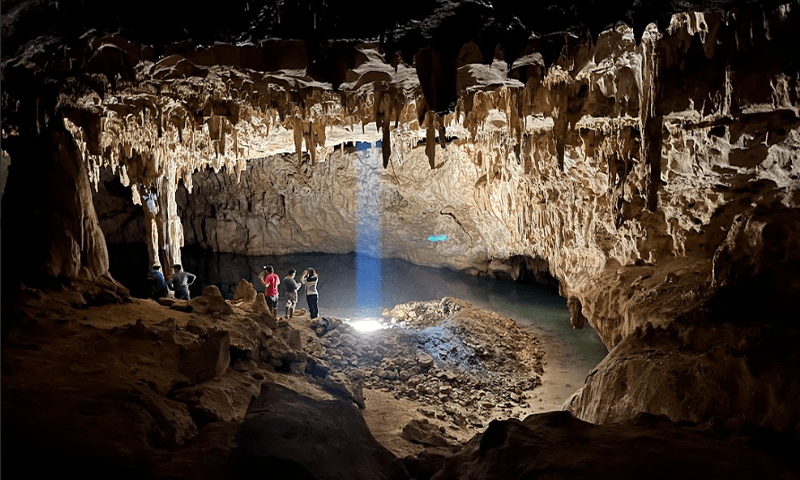
Lead photo: Tourists explore the "Dome of the Cathedral," the largest chamber in Grutas Tzabnah, the cave in Yucatán, Mexico, where the researchers found the stalagmites they studied. A human-made well ‘La Noria’ now illuminates the cave. Credit: Mark Brenner, 2023.