Sitting in an emptying bathtub and watching a vortex of water swirl down the drain is one of the simplest joys of childhood (and adulthood for those who shun showers and opt for the tub). Now this mesmerizing pleasure may help astronomers crack open the mystery of how planets form from massive rotating disks of gas, speckled with space dust.
Researchers in Germany have taken a break from complex, but imperfect, mathematical modeling to create an analog simulation of the cosmic process of planetary formation using a simple setup that replicates not only the birth of worlds but the end of bathtime. The laboratory water tornado mimics a gravitational field tugging on gas and dust orbiting a central object, and it follows most of the long-established physical laws (thanks, Johannes Kepler and your early 17th-century brilliance) that govern planetary orbits.
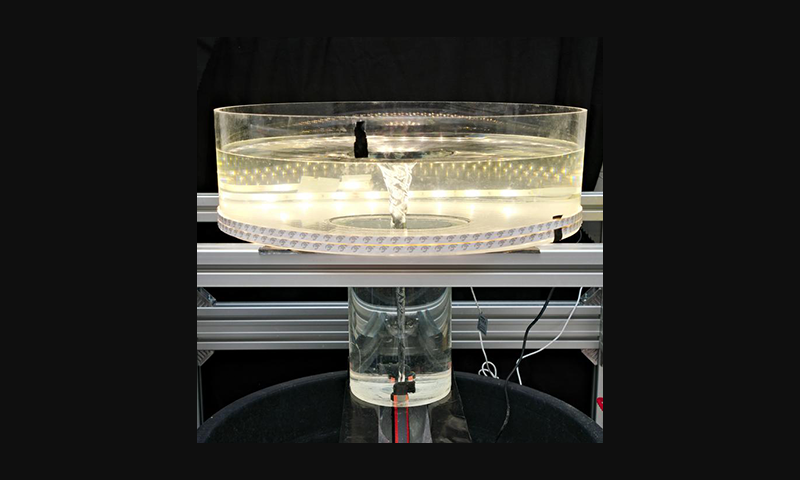
The apparatus the researchers built essentially consists of two stacked, connected cylinders filled with water, the top one wide and the bottom one more narrow. An outlet in the bottom cylinder provides the “gravity” while an aquarium pump pushes water through two nozzles in opposite directions to create the swirl. Into the vortex, the scientists—from the University of Greifswald and the Max Planck Institute for Astronomy (MPIA) in Heidelberg—inserted tiny plastic beads to simulate space dust floating on cosmic currents. Using highspeed cameras, the researchers tracked the motion of the beads and found that their trajectories generally corresponded with two of Kepler’s laws: orbital speed being highest near the central object generating the gravitational field and a close relationship between orbital period and size.
In short, the prototype was decently predictive of the behavior of dust particles in at least some of the protoplanetary disks spinning through the cosmos and birthing planets. The research team, which published its findings in the Monthly Notices of the Royal Astronomical Society Letters, now turns to optimizing the apparatus to more closely model the astronomical process. “The current results from this analogue experiment are impressive,” says Mario Flock, who leads computational studies of planet-forming disks at MPIA, in a statement. “I am confident that, with a few modifications, we can refine the water tornado model and bring it closer to scientific application.”
Perhaps those final moments of your own or your toddler’s next bath will remind you that the secrets of the universe can sometimes be found in the least likely of places. 
Lead image: This photo shows the upper part of the water tornado model. The acrylic glass tank has a diameter of 50 centimeters and is illuminated with LED strips. The water forms a vortex whose surface shape reproduces the profile of a gravitational field. The analysis showed that the motion of the water closely resembles the behavior seen in protoplanetary discs. Credit: T. Müller (MPIA / HdA)