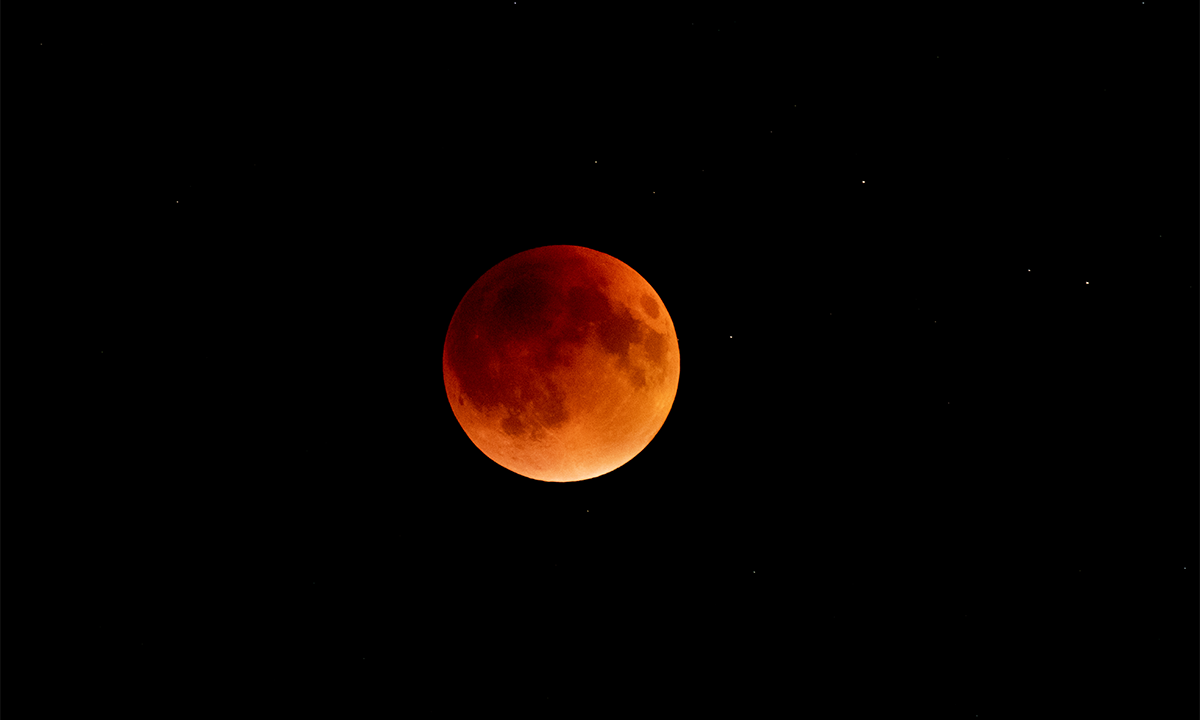
Next month, the blood moon will show its copper-toned face to about a third of the world, including North America.
This spooky nickname refers to a total lunar eclipse, when the Earth travels directly between the sun and moon. That cosmic alignment is visible around every 2.5 years from a given spot on our planet, and the next one will arrive on March 3.
We glimpse this eerie red glow because Earth’s shadow, known as the umbra, prevents most sunlight from illuminating the moon’s surface. The light that makes it there gets filtered through the Earth’s atmosphere. Colors with shorter wavelengths, like blues and violets, tend to scatter, while colors with longer wavelengths, including red and orange, reach the moon. This is the same phenomenon that gives our planet’s sunrises and sunsets their fiery hues. “It’s as if all of the world’s sunrises and sunsets are projected onto the moon,” according to NASA.
The exact color visible during the eclipse depends on the conditions of the atmosphere at the time, and it can be influenced by things like pollution, wildfires, and volcanic ash from Earth.
Long before we understood the reason for the moon’s occasional bloody appearance, people spun all sorts of stories to account for it—few of which were positive. In many ancient cultures, it signified that “things that shouldn’t be happening are happening.” E. C. Krupp, director of the Griffith Observatory in California, told National Geographic back in 2014.
In ancient Mesopotamia, home to one of the world’s earliest civilizations, people saw a lunar eclipse as a threat to the king. Mesopotamians made detailed astronomical observations and were able to pinpoint when lunar eclipses would take place. This gave them ample time to plan. During the celestial event, they swapped him with a substitute while the real king hid in safety.
Read more: “The Real Landscapes of the Great Flood Myths”
To the Inca people of what’s now South America, the total lunar eclipse indicated that a jaguar had gobbled up the moon. They worried it would arrive on Earth and consume people, too. The Inca fended off the feisty cat by encouraging their dogs to howl and shaking spears at the moon.
Hindu stories also feature the moon on a villain’s menu. Some of these folktales claim that eclipses occur thanks to the demon Rahu, who consumed an elixir that enabled him to live forever. Shortly after, the moon and sun cut off his head. His immortal noggin pursued them in order to eat them, and eclipses occur whenever he’s able to grab and feast on them. “Since his head was cut off, the sun or moon just falls out the hole where his neck used to be,” according to an article in the Library of Congress.
Other moon-eating tales have come from China and Korea, where dogs are seen as the culprit.
Christianity also offers unique perspectives on the blood moon. During the First Crusade, for instance, at the end of the 11th century A.D., historian Albert of Aachen claimed that the crusaders saw a blood moon on their way to Jerusalem. “Those who had knowledge about the eclipse as a signal of God’s will, Albert tells us, comforted the fearful,” historian Beth Spacey wrote for The Conversation.
Albert thought that lunar eclipses portended the downfall of their enemies, while some other Christian scholars from around that time urged people not to get carried away with woo-woo explanations. After all, it was already known by this time that they occur when the Earth blocks the moon. Far more recently, in 2014, some Christians saw a series of blood moons as a sign of Jesus’ return.
Whatever meaning you associate with the lunar eclipse, you can see it most clearly by moving away from bright lights. You can peer through a telescope or binoculars as well for a closer look. Check out the best times to view the eclipse near you on timeanddate.com. 
Enjoying Nautilus? Subscribe to our free newsletter.
Lead image: Yathumon M A / Wikimedia Commons