
One Saturday morning in February 2025, Colette Delawalla stood in front of her bathroom mirror in the small Atlanta, Georgia, apartment she shared with her husband and toddler. She asked herself how far she was willing to go to fight for her beliefs.
A few days earlier, Delawalla, a 30-year-old addiction researcher at Emory University pursuing a Ph.D. in clinical psychology, had received a life-altering message from her university grant office. To remain eligible for the federal grant she was counting on to fund her dissertation on alcohol-use disorder, she’d need to revise her application and remove the words “marijuana,” “opioids,” and all references to gender, race, and sexual orientation. It was an impossible ask for an addiction scientist whose research relied on a dataset chosen to reflect the demographic diversity documented in the 2020 census.
In the days that followed, the newly installed Trump administration barred government scientists from speaking at conferences or in public. The National Institutes of Health announced plans to slash $4 billion in medical and scientific research funds, and Delawalla, whose activism experience consisted of attendance at a single Black Lives Matter protest, went looking for a way to fight back. She came up empty; people seemed shell-shocked. If she wanted change, she concluded, she’d have to take matters into her own hands.
Read more: “Will the March for Science Matter?”
“Are you somebody who lives by your values?” Delawalla asked herself that morning, as she gazed at her reflection. She thought about how disappointed she had been as a child when she’d asked her grandmother, a southerner, what she had done during the Civil Rights movement, and learned that she had remained silent. She imagined her young son asking her how she responded to her moment.
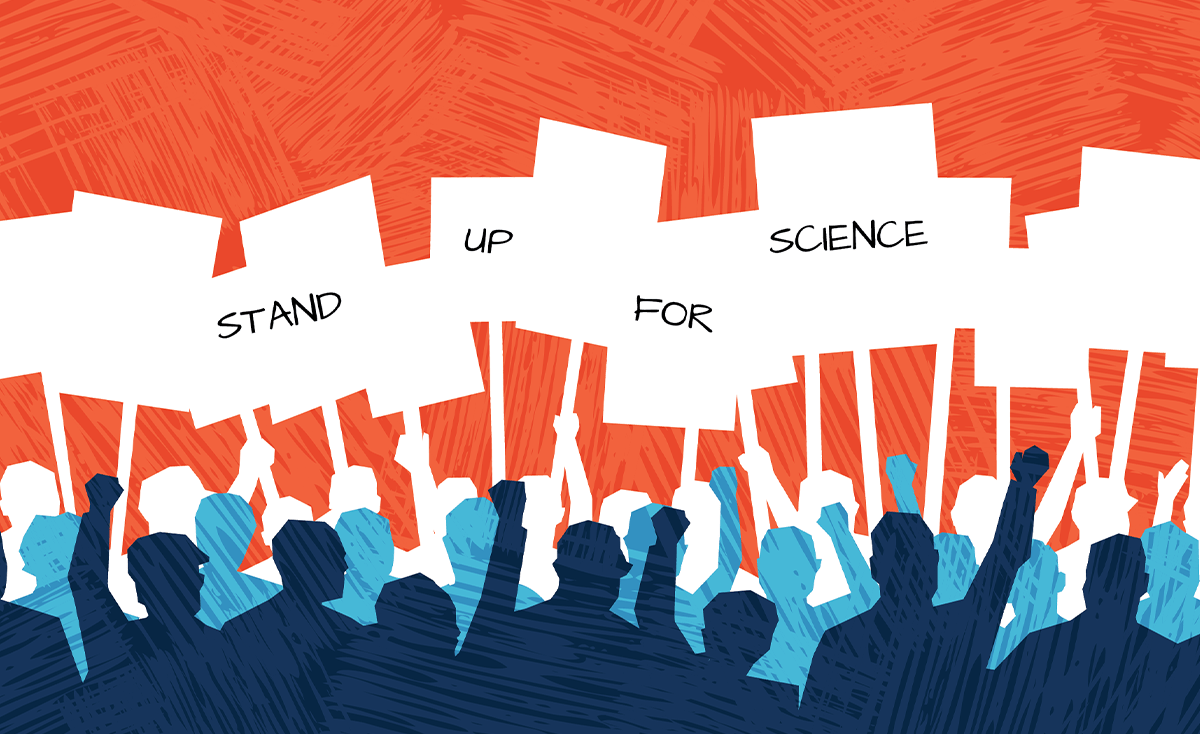
Later that day, she announced her conclusion to the world. “Can’t believe I’m typing this but … FUCK IT IM PLANNING A STAND UP FOR SCIENCE PROTEST IN DC,” she wrote on the social media app Bluesky. “If you want to be involved, dm me. I’m nervous, I’ve never done this before, but we gotta be the change we want to see in the world.”
Delawalla had no idea what she was about to unleash. Within minutes, she began receiving DMs from people who wanted to help. She started a group email thread. But within hours, it had grown so large and unwieldy, she moved it over to Discord and started a new channel. That became a website—which was so overwhelmed with traffic, it crashed within hours.
On March 7, less than a month after that initial post, thousands of protestors converged on the Lincoln Memorial in Washington D.C., to listen to a slate of speakers that included Bill Nye, U.S. Maryland Senator Chris Van Hollen, and former NIH Director Francis Collins. Smaller rallies were held in more than 130 other cities around the globe. By then, the Stand Up for Science Bluesky account had 50,000 followers and Delawalla and her allies were thinking far bigger.
Today, the organization Delawalla founded with four other early career researchers to organize the protests—Stand Up for Science—is at the center of a growing resistance movement comprised of an army of unlikely political activists. Thousands of scientists, academics, government bureaucrats, and physicians have been dragged reluctantly into a battle for survival that few saw coming. Their long-term goals and strategies are still emerging. Their short-term aims are clear—to do what they can to slow the onslaught, to get the word out, to fight back.
Over the last year and a half Stand Up for Science has held scores of additional protests across the United States. They’ve worked with Michigan Rep. Haley Stevens to write articles of impeachment against RFK Jr., then had their members deliver petitions with 150,000 signatures supporting the effort—along with 10,000 rubber ducks because, as Delawalla says, RFK Jr. is “a quack.” And they’ve won their first victories—small ones that are a preview of what they might achieve in the years ahead, as their growing political infrastructure and army of activists matures.
“Our mission is to mobilize the fight for science and democracy—we view the two things as deeply intersecting—and to really give scientists a pathway and a way to engage in civic action while also educating the public,” Delawalla says. “The strategy is to flood the zone.”
For Delawalla and many of the nation’s scientists, the stakes couldn’t be higher. Since assuming office for his second term, Trump and his allies have set out to fundamentally reshape federal science policy, cutting billions of dollars in federal research funds needed to fund the work of independent investigators at American academic research institutions, withdrawing government support from diversity and climate-related initiatives, and redirecting basic science, biomedical, and academic research money to areas of the Trump administration’s choosing.
In May, the administration unveiled what some have characterized as its most far-reaching power grab yet, unveiling a proposed rule that would empower political appointees to override the recommendations of scientific peer-review panels and cancel new grants that don’t align with the president’s “policy priorities.” The rule, according to Elizabeth Ginexi, a health scientist and an increasingly prominent member of Stand Up for Science’s influencer army, is notable not just for what it would do, but for what it cites as its justification.
“It characterizes decades of peer-reviewed research on climate, public health, equity, and international collaboration as ‘woke,’ ‘neo-Marxist,’ ‘anti-American,’ or ‘divisive ideology,’” she wrote on Substack. “It treats the scientific community’s professional infrastructure, including conferences, journals, international partnerships, and open access publishing, as wasteful overhead to be controlled or eliminated.”
Ginexi is typical of the new breed of scientist-activists who have joined Delawalla in the trenches. When Trump swept back into power, Ginexi was an apolitical government bureaucrat in her 21st year as a scientific program official at the NIH. At the time, she was working in the National Center for Complementary and Integrative Health, a relatively small NIH center that funded research into non-traditional approaches to treating pain and improving physical and mental well-being. She oversaw a portfolio of research grants and helped to decide which projects in her area of focus were deserving of new ones.
But within weeks of Trump’s inauguration, she was told she was not allowed to fund grants or speak with her grantees. More than half of those working her small office lost their jobs. Sitting in her office as the hours ticked by, Ginexi contemplated her future and came to a decision. “We weren’t going to be doing science anymore,” she concluded. “We’d be filtering grants and canceling grants and doing illegal things or pandering to RFK Jr. And I decided I didn’t want to do that for a living.”
So, in April 2025, Ginexi logged onto a virtual meeting with her Human Resources department, detailing the steps necessary to accept the Trump administration’s “early retirement” offer. She was one of 500 NIH staffers on the call. Most of them were on their way out, and many were openly weeping—including the HR staffers explaining the paperwork. It was her last day in government.
Once she hit the labor market, Ginexi discovered there were no jobs. The flood of former government bureaucrats, displaced would-be graduate students, unemployed scientists, and all the others had overwhelmed the market. So Ginexi joined the resistance and began writing.
Today, she spends her days strategizing about teach-ins and congressional outreach over encrypted messaging apps. She is on a Signal thread with a group called Defend Public Health, comprised mainly of former CDC officials, and a separate thread filled with fellow NIH exiles affiliated with a group called 27 United (there are 27 institutes and centers at the NIH). She’s working with the Save America Movement, started by disenchanted former Republicans, and with Stand Up for Science.
“I’m only in a small fraction of the number of these coordinating groups,” she says. “There are literally hundreds of groups. I can’t even quantify. It’s very organic and time-fluid and time-sensitive.” Each of these groups is “rowing in the same direction,” but is working on “different pieces of the puzzle,” relating to their areas of expertise.
Read more: “They Came for Climate Science. Then the Storms Came.”
After joining the resistance, Ginexi, like Delawalla, and a growing number of activists, reached a stark conclusion: Neither Democrats—much less Republicans—nor the mainstream science groups the scientific establishment had long relied upon to advocate for their interests were doing enough to fight Trump’s devastating cuts to science. “The only hope was to harness the anger and outrage into grassroots activism,” Delawalla says.
Ginexi, for one, was too outraged to sit back and stay silent. To her, things seemed crystal clear. There was no point in traditional debate because Trump’s scientific agenda was not motivated by subtle differences in philosophy or policy. Trump’s policies were motivated by greed. “The goal here is not to make America stupid. The goal is to completely dismantle the scientific infrastructure that interferes with their deregulation agenda,” Gilexi says. “They don’t want anyone to stop their billions.”
“And let’s be clear,” Ginexi adds. “The Republicans have no interest in stopping this or fixing it,” she says. “The only party that might want to fix things is not in power and we have no idea when they’ll be in power. Even if they win back the House and/or the Senate this fall, they still won’t be able to fix it because Trump’s still in office. Realistically, any ‘fix’ is not going to happen till 2029 or ’30. By that time, everything will be destroyed. We’ll have to have a complete rebuild of every federal agency. We’re just trying to put our fingers in the dike and try and stave off the worst of the worst.”
And that means dispensing with the old playbook. There may be a place for letters, petitions, policy papers, and polite discussion. But only in conjunction with far more aggressive actions. “We can’t bring a handshake to a nuclear bomb fight,” Gilexi says.
Gretchen Goldman is the president and CEO of the Union of Concerned Scientists, among the most well-known science advocacy organizations, with a network of 20,000 scientists. She says she recognized the need for new tactics to combat the Trump assault on science. She assumed her role in the early months of the Trump administration, fresh off a four-year stint working for the Biden White House in the Office of Science and Technology Policy. She spent her first year with the Union of Concerned Scientists exploring “what was effective and what wasn’t” in the new era. Then she delivered a stark message to her troops. “We need to up our game. We need to do something different. We need to recognize what this moment is.”
In early June, she launched an initiative called “Science Rising,” announcing a major shift in priorities and approach. “We don’t have time to do a nice long thought piece in a scientific journal about the context,” she says. “They will already have smashed seven more things by then. You’ve got to be quick in terms of shaping the narrative and telling the story and recognizing impacts and educating the public and decision makers about what to do.”
Goldman says the Union of Concerned Scientists is positioned to help combat the “culture of fear” that has led to a silence from university scientists and administrators. It’s imperative, she says, to combat the “every-man-for-himself mentality where everybody just wants to be not the target,” and promote unity. The Union of Concerned Scientists has launched educational efforts aimed at promoting “scientific courage” by explaining how members can get involved, advocating with members of Congress and through the media, and using their expertise to build support. Although the group has no in-house lawyers, they have been working with legal organizations like Democracy Forward and Public Citizen, getting actively involved in lawsuits as plaintiffs or co-plaintiffs, writing amicus briefs and providing member scientists to provide expertise and background.
“We have to be thinking about what comes next and what to do in a world where it’s not going to be the same,” she says. The Trump administration “dismantled a lot of science infrastructure and fired a lot of people who had institutional knowledge. It’s not going to be as easy because of the level of destruction that we’re seeing now. But every day that goes by that we’re allowing more destruction is a day that we will be harder to come back from. There’s urgency to do everything we can right now.”
The urgency has spurred the Union of Concerned Scientists to row in the same direction as the grassroots groups. And it has scored some victories. Last year, when the Trump administration enlisted climate change deniers to write a report for the Department of Energy to justify the repeal of an EPA finding on climate change, the Union of Concerned Scientists and the Environmental Defense Fund sued and prevented the report from being released.
They argued successfully that the report violated the Federal Advisory Committee Act, which states that scientists from outside of government must follow a litany of rules, including being vetted to make sure they don’t have conflicts of interest, and that their deliberations are done with transparency. To the scientific activists, the conflicts of interest were apparent. And the decision by the Trump administration to abandon the effort to stamp the report with the imprint of the DOE suggests they were right.
Nevertheless, the Trump administration still rescinded the EPA’s formal 2009 scientific and legal determination that greenhouse gases—including carbon dioxide—endanger public health and welfare by causing climate change. (A finding made under the Clean Air Act.) But they were unable to produce new scientific evidence showing that climate change is not caused by greenhouse gas pollution. Instead, they emphasized the economic costs of climate regulations and suggested those costs justified rolling back the finding. The rescission is now the subject of extensive litigation.
Read more: “The Extraordinary, Imperiled Science at the End of the Earth”
Stand Up for Science can also point to signature victories. They helped derail an ill-conceived initiative pushed by RFK Jr. to replace a nationwide infant hepatitis B vaccine drive in the tiny African nation of Guinea-Bissau with a clinical trial co-funded by the CDC and the New York City-based hedge fund, Pershing Square.
Since May, Stand Up for Science has fueled tens of thousands of citizens to oppose the Trump proposal to shift approval of science grants from independent peer reviewers to political appointees aligned with Trump’s priorities. “If we hadn’t made a big deal of this, there would have been less than 1,000 comments,” Delawalla says.
Senate allies folded provisions into a stopgap spending bill that will halt the implementation of the proposal. The House must still cast its vote on the proposal and the Senate may revisit it again. But the provision was a “major victory,” Delawalla says. It previews the power of the new movement for the political battles ahead. For Delawalla, mobilizing scientists has been a huge victory in itself.
“Scientists are unbelievably difficult to mobilize,” Delawalla says. “Our victory is that we built political machinery for them in the United States. The fact that we didn’t put up any sort of resistance before is part of the reason why we even ended up in this situation. Once we get through the upcoming midterms, and we have some levers of power to pull, goodness, we’ll pull them.” 
Lead image: TeddyandMia / Adobe Stock