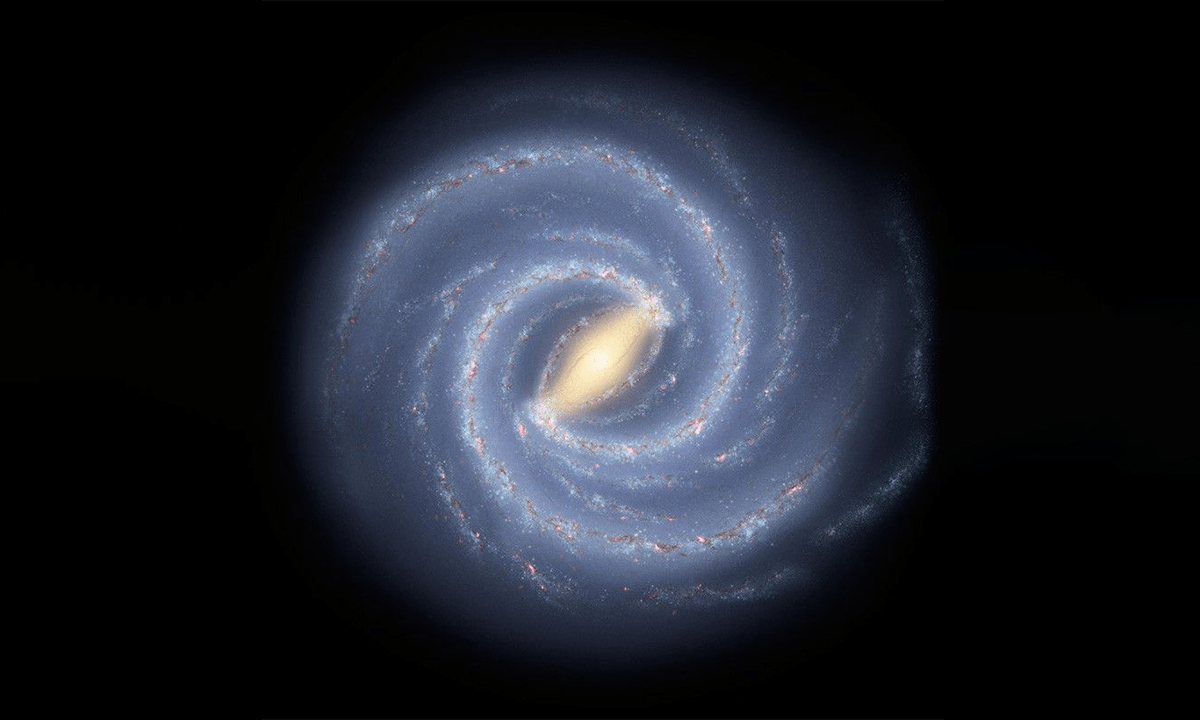
The Milky Way evolved billions and billions of years ago when clouds of cosmic matter coalesced into a spheroid halo that then collapsed into a spinning disk.
Or so goes the peaceful model of our galaxy’s origins. More recent evidence has revealed that the Milky Way had a turbulent youth, gobbling up other galaxies to form the expansive spiral system we know today. In particular, new research published in Monthly Notices of the Royal Astronomical Society details one of the Milky Way’s potential conquests—a dwarf galaxy whose stellar remnants became part of our own.
The first stars to emerge after the Big Bang were mostly composed of hydrogen and helium, simple elements that were abundant at the time, and many of these slow-burning stars are still around today. After several billions of years of stellar evolution and fusion, stars began producing heavier elements, like metals. In fact, the metal content of stars is one way astronomers can assess their relative ages.
Read more: “The Myths and Lore of the Milky Way”
After studying the chemical composition of 20 “metal-poor” stars, an international team of astronomers determined they likely originated within another galaxy altogether, one they’ve termed “Loki.” While metal-poor stars aren’t uncommon in our galaxy’s halo—a spherical area surrounding the spiral—this cluster is in the galactic disk. Essentially, these metal-poor stars are more incorporated into the Milky Way than their ancient chemical compositions suggest they should be.
“These building blocks merged together at early epochs, dispersing their stellar, gaseous, and dark matter content into the forming proto-galaxy,” the authors wrote. “Therefore, the most metal-poor stars coming from the early galactic assembly are supposed to populate the inner regions of the Milky Way, while those accreted later might be dispersed in the outer halo.”
Of course, Loki isn’t the only galaxy the Milky Way consumed. Research published in 2020 reveals an immense galaxy termed “Kraken” merged with our own around 11 billion years ago, one of the most formative experiences for our young galaxy. Since then, things have calmed down a bit, but we may still be on a collision course with the Andromeda Galaxy, our largest neighbor.
At least we have a few billion years to prepare. 
Enjoying Nautilus? Subscribe to our free newsletter.
Lead image: NASA/JPL-Caltech