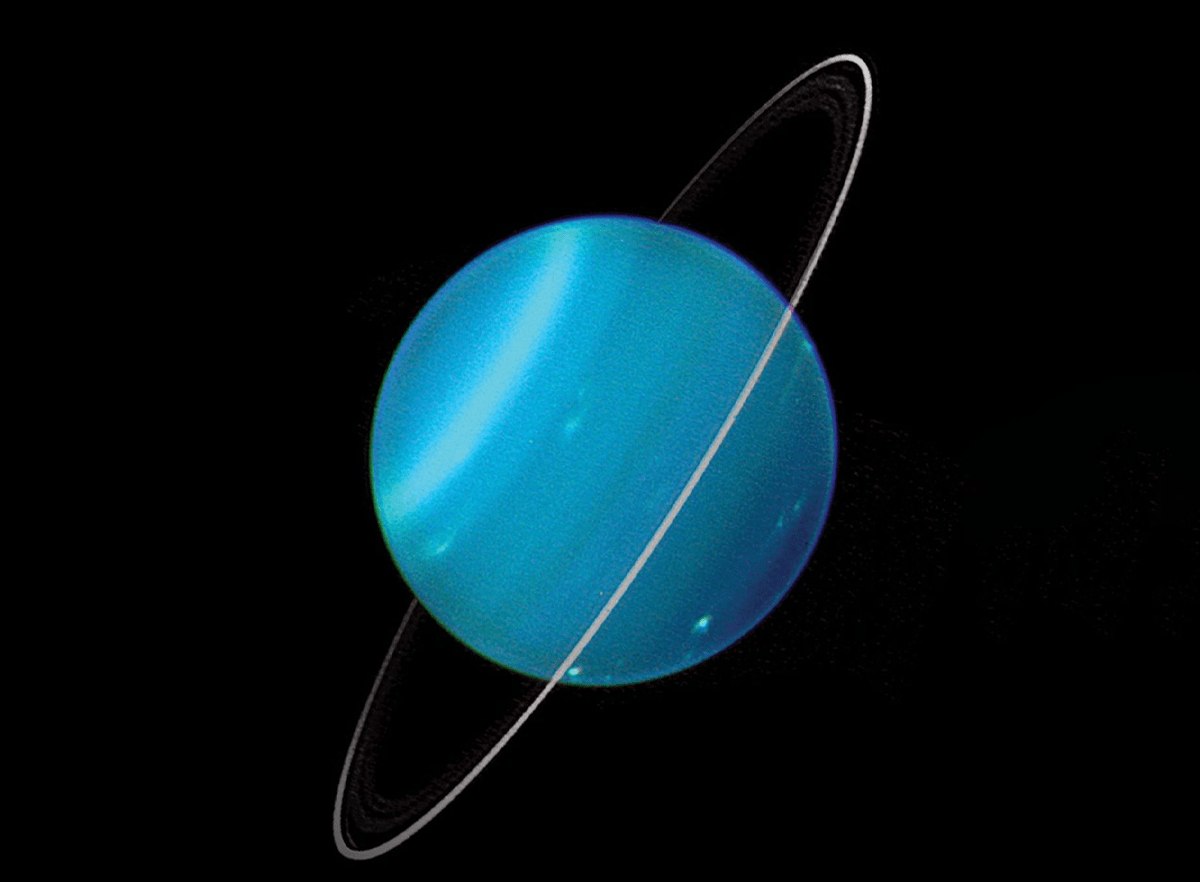
The rings of Uranus have fascinated astronomers since they were discovered in 1977, but there’s a lot we still don’t know about them. In 1986, Voyager 2 conducted the only flyby of the distant planet, discovering two additional rings, and still two more were detected by the Hubble Space Telescope in the early 2000s, bringing the total to a lucky 13. Now scientists are investigating the origins of those distant rings—and their research may offer clues that the icy planet is harboring a hidden moon.
Astronomers combining observations from the Keck Observatory with data from the Hubble and James Webb Space Telescopes recently completed the first reflectance spectrum of the two outermost rings of Uranus and published their findings in the Journal of Geophysical Research: Planets.
“By decoding the light from these rings, we can trace both their particle size distribution and composition, which sheds light on their origins, offering new insight into how the Uranian system and planets like it formed and evolved,” study author Imke de Pater of the University of California, Berkeley, said in a statement.
Prior observations from both Keck and Hubble revealed that the outermost µ (mu) ring appeared to be blue, indicating it was composed of very small particles, like Saturn’s E ring. On the other hand, the slightly closer ν (nu) ring had a faint reddish tint, suggesting it was mostly dust. Adding images taken from the James Webb Space Telescope allowed researchers to compile a more complete picture of the rings, reflecting a wider range of the electromagnetic spectrum.
Read more: “The Planets with the Giant Diamonds Inside”
Analyzing which wavelengths of the spectrum the rings absorbed gave the team clues to their composition. The µ ring matched the spectral signature of frozen water, indicating it was composed of tiny grains of ice. The ν ring, on the other hand, was composed mostly of rocky material with 10 to 15 percent organic compounds.
So where did the rings come from?
The Uranian moon Mab orbits the planet at the same distance as the µ ring, which seems to have formed from frozen particles knocked loose by micrometeorites hitting Mab’s frigid surface. This dynamic is similar to the relationship between Saturn’s moon Enceladus and its E ring, the only other blue ring in the solar system. They’re also the same distance from their home planet, but in Saturn’s case, the E ring was formed by volcanic activity on Enceladus spouting ice into space.
The origin of Uranus’ ν ring remains something of a mystery, however. “The ν ring material is sourced from micrometeorite impacts on and collisions between unseen rocky bodies rich in organic materials, which must orbit between some of the known moons,” explained de Pater. “One interesting question is why the parent bodies sourcing these rings are so different in composition.”
While the other moons of Uranus are all rocky, none of them are close to the ν ring. Is there some hidden moon or other object nearby kicking up dust? Also, why is Mab the only icy moon orbiting Uranus?
Unfortunately these questions—and many others—will have to wait until we can visit the distant planet once again. Until then we’ll be left to ponder its many hidden secrets from afar. 
Enjoying Nautilus? Subscribe to our free newsletter.
Lead image: NASA