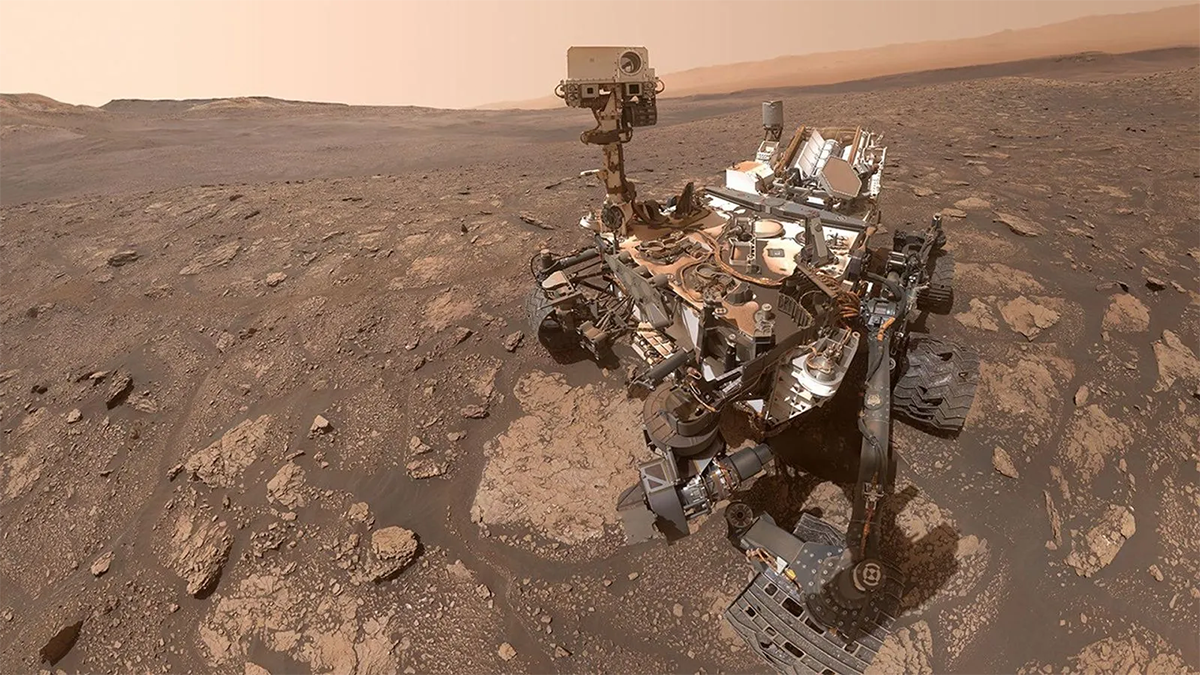
NASA’s Curiosity rover has been trundling around Mars since it touched down on the surface almost 14 years ago. The car-sized, nuclear-powered robot’s mission is exploring the geology of the red planet, including whether it could have supported life at some point in its history. To handle the task, Curiosity is equipped with a suite of scientific instruments, including a drill mounted on its robotic arm for extracting samples of rocks.
On April 25, the drill got stuck. The snag happened when Curiosity was attempting to take a sample from a rock nicknamed “Atacama.” After drilling into the almost 30-pound stone, Curiosity retracted its arm, and Atacama came with it.
Read more: “Make Mars Great Again”
The situation caused some understandable concern back at mission control. After all, Curiosity’s drill is notoriously finicky. In 2015, an intermittent electrical short in the drill led NASA to pause its operation. In 2016, another malfunction in the motor, likely caused by debris, paralyzed Curiosity’s robotic arm for more than a week, preventing the rover from roving. While NASA engineers were able to get the robot on the mend again, drilling operations were suspended for over a year as the team meticulously worked to isolate and fix the problem.
So a stuck rock was no laughing matter. Unfortunately, the rock was lodged on the fixed metal sleeve surrounding the drill, rather than the drill bit itself, so simply reversing it wouldn’t help. After trying to shake the stone off by vibrating the mechanism failed, the Curiosity team twisted the arm around and tried again four days later. Still nothing. Finally they tilted the mechanism, rotated and vibrated the drill, and even spun the bit. This time, Atacama came loose, dropping to the surface and shattering.
After almost 14 years on the job and a number of close calls, Curiosity will live to drill again. 
Enjoying Nautilus? Subscribe to our free newsletter.
Lead image: NASA/JPL-Caltech/MSSS