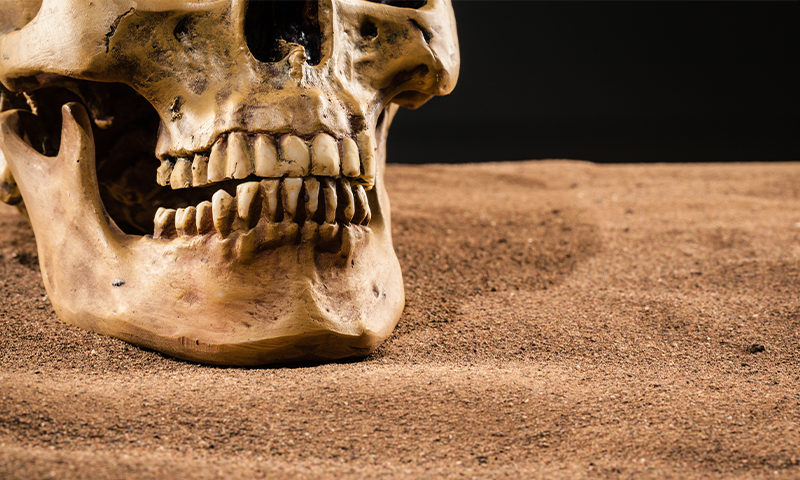
For nearly 4,000 years, a Bronze Age man’s skeleton lay quietly hidden in a limestone cave in Ireland. But recently, his remains, including a couple of well-preserved molars, came to light. Those teeth tell a new story about the connection between modern diets and cavity-causing bacteria.
Lara Cassidy, a geneticist at the Trinity College Dublin who specializes in ancient human DNA, was surprised to find an abundance of genetic material from Streptococcus mutans, one of the major causes of cavities and tooth decay, on the ancient man’s teeth. It’s a species that is rare in the ancient genomic record—for a few reasons. The bacteria is acid-producing, which degrades DNA and prevents fossilization of dental plaque, the material scientists use to sample oral bacterial DNA. But the limestone of the cave in which the teeth were found, in Killuragh, County Limerick, is alkaline, which likely helped to neutralize the acid and preserve the genetic material.
The other reason S. mutans is so rare in the ancient genomic record is that the human mouth wasn’t a very hospitable place for it during most of history. “It's really with the rise of processed foods and particularly processed sugar and sucrose that it has become very dominant and very common in the modern mouth,” Cassidy says. Cavities are caused by lactic acid produced by a number of oral bacteria when they consume sugars and other food on the teeth. This acid breaks down the tooth enamel.
Cassidy and colleagues used the ancient man’s molars to reconstruct the first ancient genome for S. mutans. The new data, analyzed in conjunction with modern genomes, allowed them to build a picture of the evolution of the bacteria across millennia for the first time. Previous work with modern oral microbiome genomes suggested that S. mutans populations increased following the adoption of cereal agriculture 12,000 years ago. But the new findings indicate they really skyrocketed around 250 to 750 years ago, when sugar and processed carbs, such as rice and bread, became a big component of human diets. S. mutans particularly loves sucrose, Cassidy says. “It helps it create the sort of sticky film that this bacteria uses to colonize the tooth surface so it can consume all different sugars.”
Ancient people used twigs and kinds of different fibers to clean the teeth.
The study results also demonstrate a loss of diversity in the oral microbiome since the time of the Bronze Age man, as well as an increase in its ability to cause disease. In addition to S. mutans, the researchers collected and analyzed another bacteria named Tannerella forsythia, which is associated with gum disease, from the man’s teeth. They found far greater genetic diversity in the ancient T. forsythia than is present in its modern genome, with a sharp decline occurring at the dawn of the industrial era. This loss of diversity could potentially make humans more susceptible to other oral pathogens, the researchers write. In addition, their analyses allowed them to identify a sharp increase in virulence—the ability to infect and cause disease—for both bacteria in the post-industrial age. These shifts in genetic diversity and virulence could have important implications for human health overall, as the oral microbiome has links with the immune system, neurodegenerative disease and overall systemic health.
The researchers published their findings in March in the journal Molecular Biology and Evolution. They were able to build an entire genome for ancient S. Mutans for the first time because of the large quantity of the bacteria present on one of the Bronze Age man’s teeth when he was alive. So much S. Mutans bacteria would likely have led to cavities had he lived, says Cassidy. The man’s diet would have included some barley, other grains, and some fruit—all foods that appeal to the S. Mutans bacteria—but would not have been as rich in sugars and processed carbs as the modern diet, she says. Ancient people had their own methods of oral hygiene: Twigs and kinds of different fibers were often used to clean the teeth.
The study left Cassidy with a new appreciation for how quickly the bacteria in human mouths have changed in a short time frame. Oral microbiomes were quite stable for thousands of years—there aren’t huge differences between medieval genomes and prehistoric ones when it comes to the bacteria we carry in our mouths. But in the industrial period, our diets began to evolve rapidly, and oral bacteria evolved with them.
It’s quite striking how much change has happened in the past few hundred years, she says. “That actually might affect the microbes that live alongside us and who have evolved to be adapted to a certain type of environment that we're providing for them with our diets,” she says. “Another take home message is to remember to brush your teeth.” 
Lead image: Dario Lo Presti / Shutterstock