According to the basic approximation, stars are formed by a stately, gradual process that belies the power it eventually unleashes. Within a great gas cloud, gravity slowly pulls together disparate tendrils into a core that grows ever denser. When the cloud’s mass is enough to overcome the gas’ internal pressure, its gravity suddenly collapses much more material into the relatively small core and begins to fuse hydrogen into helium.
But astronomers have known for some time that the real story wasn’t that simple. The cloud’s rotation and magnetic pressure, for instance, pull the strands of the nascent star apart. Perhaps the most complicated part of the system is turbulence, which tends to whips gas clouds into chaotic vortexes. But we’re recently getting a better handle on how turbulence affects these systems. The more we know about them, the clearer it becomes that turbulence is a key factor in how many stars are born.
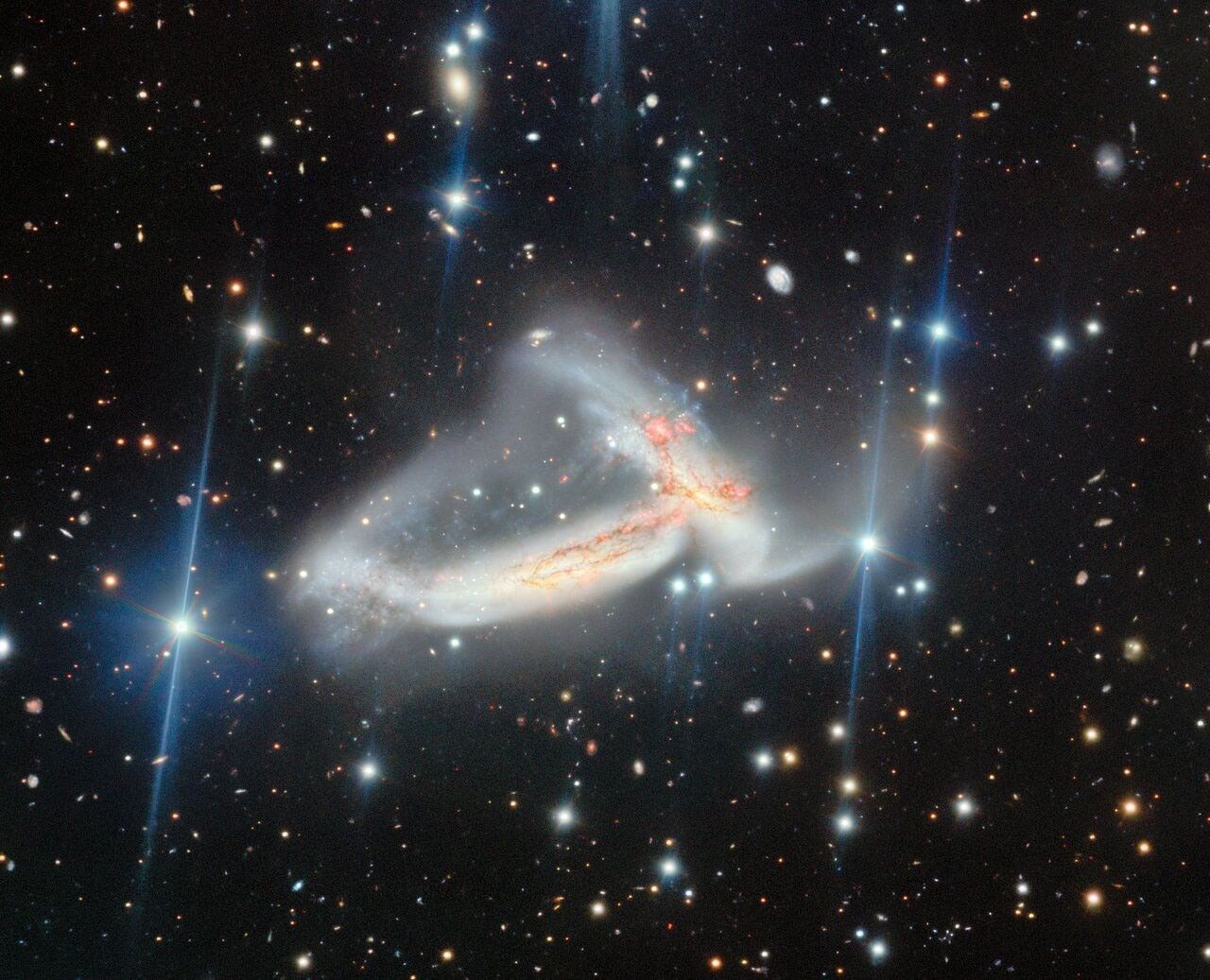
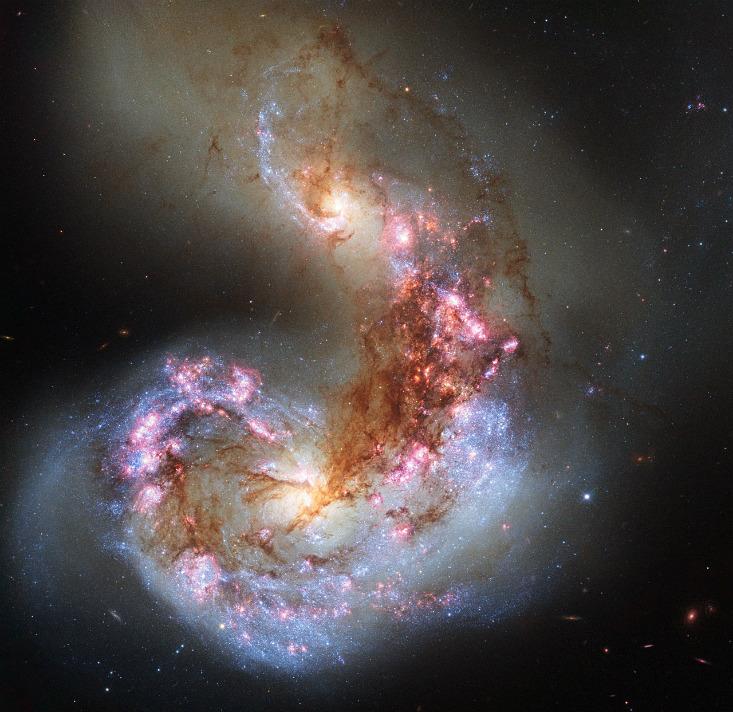
One long-standing puzzle in the study of star formation is the existence of “starbursts”: the dramatic appearance of groups of stars in the region where two galaxies collide. According to the simple model of star formation, turbulent vortexes formed by the collision should interfere with the gradual collapse of gas clouds, preventing them from forming stars. Judging by the beautiful images seen of starbursts—as in the Antennae Galaxies above—there was obviously something missing from that model.
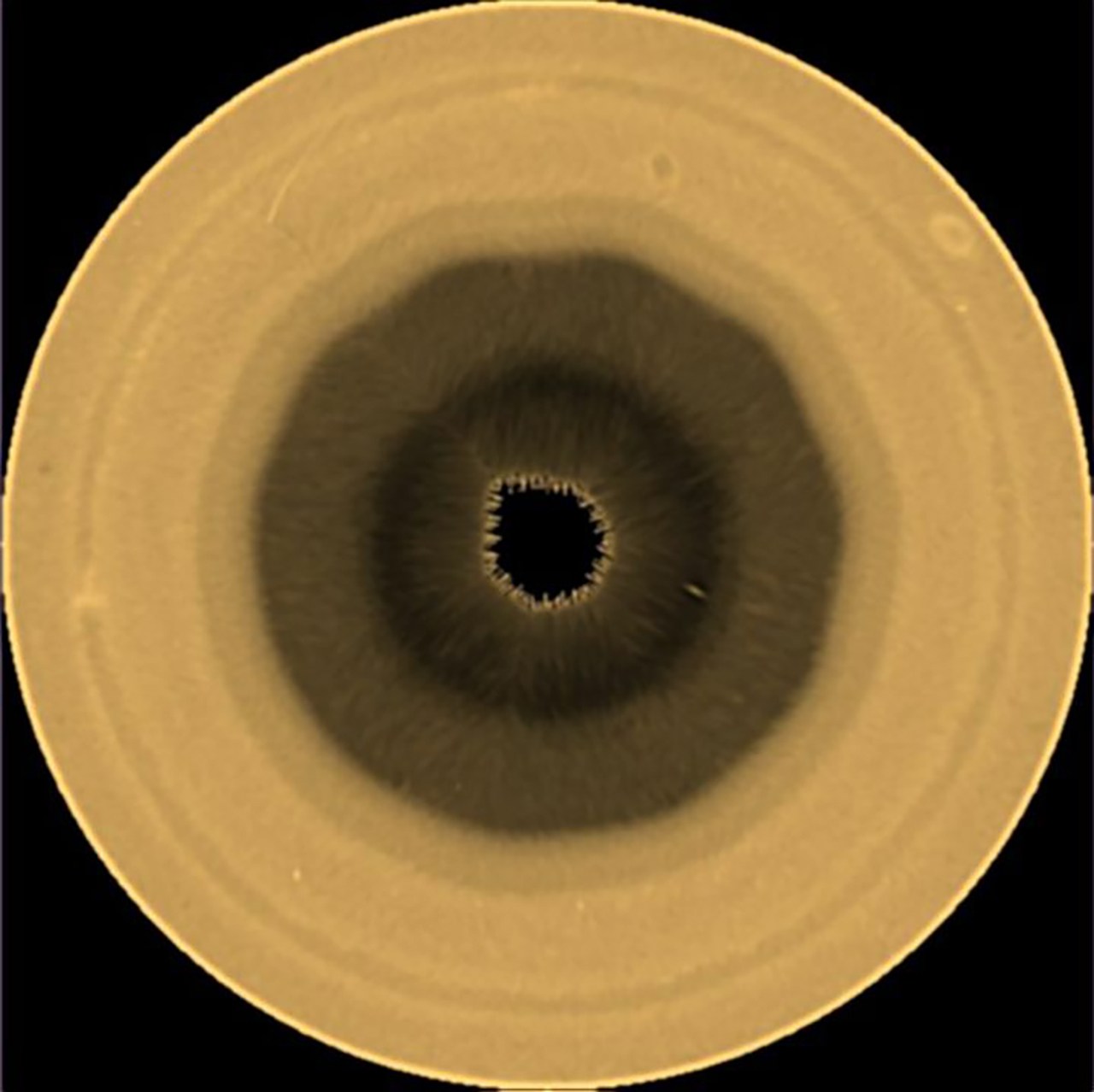
The mystery remained until a group of French researchers hit the astrophysicists’ lottery: They got to run a simulation using a huge amount of time on a supercomputer, spread over eight months. Thanks to 8 million computing hours on the 4,096-processor SuperMUC machine, the researchers were able to simulate the collision of the two Antennae Galaxies and model what’s happening inside a cube with edges 600,000 light-years long, down to a resolution of 3 light-years. The simulation showed that instead of the hallmark eddies, the colliding galaxies produced a form of “compressive turbulence.” That compression pushed together gas clouds to high enough density to jump-start fusion in many places. The researchers’ write-up was accepted into the May 2014 Monthly Notices of the Royal Astronomical Society. (See one image from the simulation below, and see a video here.)
Another study, posted last month and yet to be peer reviewed, advanced another, stranger way that turbulence could birth stars. The author, Caltech physicist Philip Hopkins, focused on a phenomenon called “preferential concentration.” When turbulent vortexes are swirling with particles that are on the same size scale as the vortexes themselves, the particles tend to get shoved out of the eddies and concentrated in the spaces in between. (Preferential concentration was also recently advanced as an explanation for the mysteriously fast formation of raindrops.) Hopkins suggested that turbulent eddies could thereby cause the accumulation of enough matter in small enough regions to precipitate gravitational collapse. The bizarre part of the study is that this method would preferentially contentrate not hydrogen or helium, the usual components of stars, but heavier elements instead. Since astrophysicists call any but the lightest elements “metals,” Hopkins titled his paper, “Some Stars are Totally Metal.” If he is right, then there are some bizarre stars waiting to be discovered out there.
Amos Zeeberg is Nautilus’ digital editor.