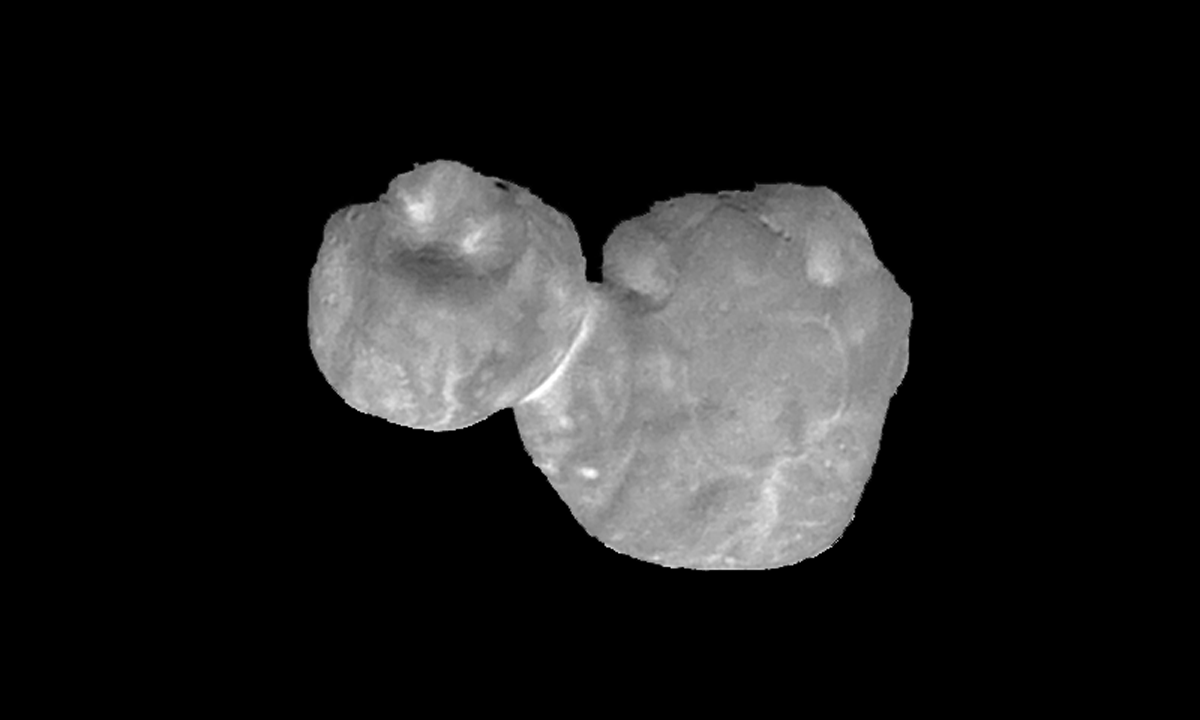
On the outer edge of our solar system, past Neptune’s orbit, lies the Kuiper Belt, a wide band of small bodies drifting lazily in orbit around the sun. Leftover from the formation of the solar system, this collection of cosmic crumbs includes dwarf planets as well as smaller planetesimals primarily composed of ice, methane, and ammonia.
Many of these planetesimals—nearly 1 in 10—look oddly like snowmen, with one smaller sphere glommed on to a larger one. Now, new research published in Monthly Notices of the Royal Astronomical Society offers a simple explanation as to why.
Called contact binaries, these icy snowmen have puzzled researchers for years. Earlier models treated colliding bodies like fluids, which would result in one sphere, not two. Other theories involved events so rare and convoluted that they’re unlikely to be responsible for such a high proportion of contact binaries.
“If we think 10 percent of planetesimal objects are contact binaries, the process that forms them can’t be rare,” study author Seth Jacobson of Michigan State University said in a statement.
Read more: “Why It’s Hard for Black Holes to Get Together”
Instead, Jacobson and co-author Jackson Barnes used powerful computer simulations to test a gravitational collapse model for the formation of these wayward snowmen. “Gravitational collapse fits nicely with what we’ve observed,” Jacobson said.
In this model, during the early years of our solar system, when it was nothing more than a cloudy disc of dust, tiny pebble-sized bits of matter accreted together forming planetesimals. Occasionally, the rotating cloud would swirl in on itself, tearing planetesimals into two spheres orbiting one another in a cosmic pas de deux until they finally touched and fused into the oblong objects we see today.
While planetary scientists have debated the gravitational collapse model for years, this is the first time it’s been demonstrated with computer simulations. “That’s what’s so exciting about this paper,” Barnes enthused.
Going forward, the researchers hope this new model will help scientists better understand more complex systems featuring three or more bodies interacting in space. Until then, they can keep watching the skies for signs of a top hat-shaped planetesimal to complete the snowman look. 
Enjoying Nautilus? Subscribe to our free newsletter.
Lead image: NASA