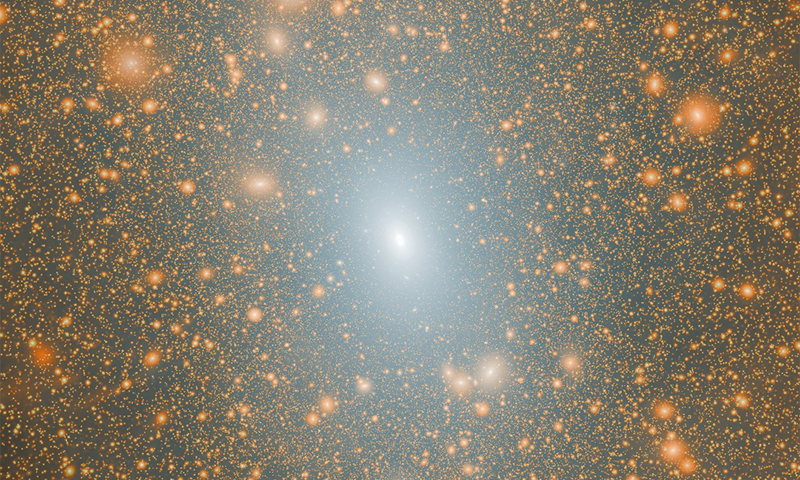
Our cosmic neighborhood may be teeming with hidden galaxies. And if new simulations that suggest the existence of such features are borne out by actual observations, we may better understand how our universe is built and how galaxies form in the first place.
A team led by cosmologists at Durham University in the United Kingdom have proposed the locations of 80 to 100 small, faint orphan galaxies that have thus far evaded both detection by telescopes and previous attempts to use cosmological simulations to pinpoint them. But the researchers used the highest-resolution supercomputer, paired with new mathematical modeling approaches, to predict that these star clusters may be hiding near our own Milky Way.
The orphan galaxies have proven so hard to find because, if they exist, they are exceedingly dim and tiny, formed in the centers of globs of dark matter that cosmologists call halos. Something called the Lambda Cold Dark Matter (LCDM) theory—also known as the standard model of cosmology—predicts that such galaxies have been orbiting larger galaxies, such as the Milky Way, since shortly after the universe was born. As time wore on, the orphan galaxies would have lost much of their dark matter and stellar mass, making them low-mass and dim, lurking in the cosmic shadows of their larger galactic neighbors.
If newly activated telescopes and cameras, such as the instruments housed at the Vera C. Rubin Observatory, can catch glimpses of these dwarf, orphan galaxies for the first time, astronomers could plug some holes in the LCDM theory left by the inability to detect them.
“We know the Milky Way has some 60 confirmed companion satellite galaxies, but we think there should be dozens more of these faint galaxies orbiting around the Milky Way at close distances,” says lead researcher Isabel Santos-Santos, a Durham University physicist, in a statement. “If our predictions are right, it adds more weight to the Lambda Cold Dark Matter theory of the formation and evolution of structure in the Universe.”
Santos-Santos and her colleagues are presenting their findings and the above image at the Royal Astronomical Society’s National Astronomy Meeting being held at Durham University today. 
Lead image: The Aquarius simulation, the Virgo Consortium/Dr Mark Lovell.