Just like us, galaxies typically go through an awkward period during their adolescence. Recent research found that young galaxies collide and merge with other galaxies, developing clumpy, asymmetric “battle scars” and bursts of stellar activity. It takes billions and billions of years for a galaxy to settle and mature into the majestic spiral-armed formations we’re familiar with.
Or so we thought.
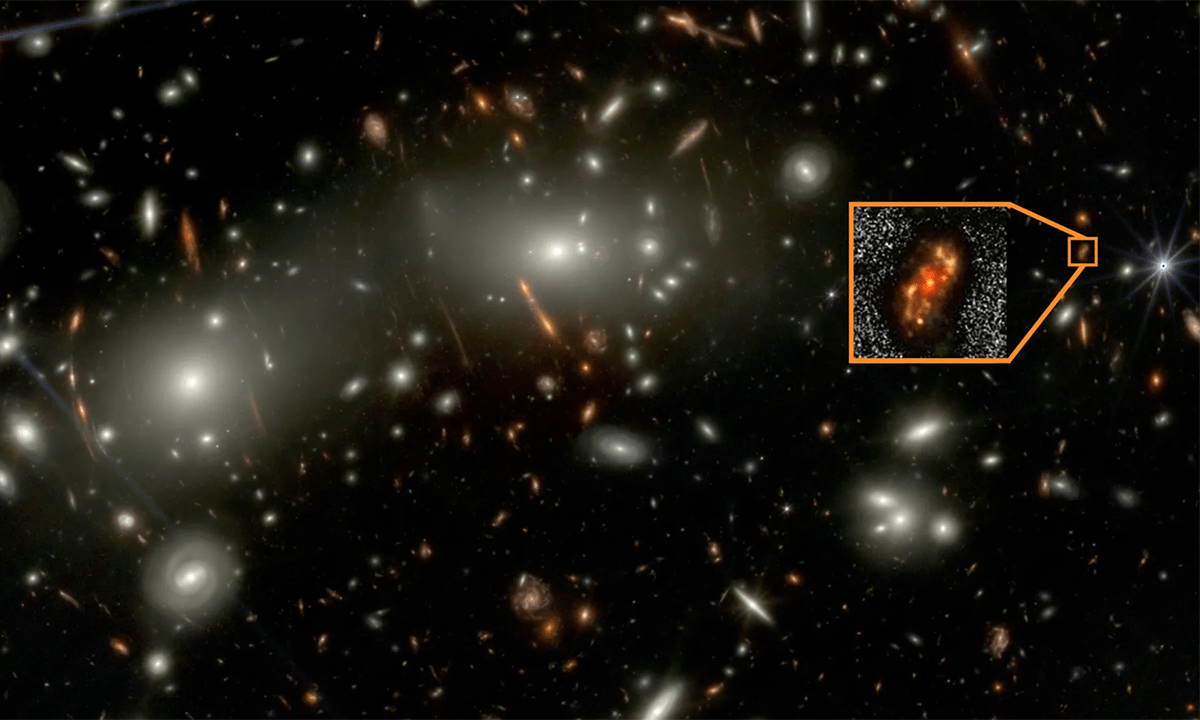
Astronomers Rashi Jain and Yogesh Wadadekar were recently surprised to find a relatively young galaxy in pristine condition, spiral arms and all. Using deep imaging from the James Webb Space Telescope, they observed a galaxy bearing a striking resemblance to our 13.6-billion-year-old Milky Way, but one that formed only 1.5 billion years after the Big Bang, when the universe was one-tenth its current age. They named the galaxy “Alaknanda” after one of the two headstreams of the Ganges River in India (the other, Mandakini, is the Hindi word for Milky Way). They published their findings in Astronomy & Astrophysics.
A mature galaxy like ours has what’s called a “grand-design” spiral, or two massive arms swirling outward from the center that astronomers long believed needed billions of years to accrete enough material. Alaknanda appears to have achieved this feat in record time.
Read more: “Star Siblings Tell Tales of Galactic Chaos”
“Alaknanda has the structural maturity we associate with galaxies that are billions of years older,” Jain explained in a statement. “Finding such a well-organized spiral disk at this epoch tells us that the physical processes driving galaxy formation—gas accretion, disk settling, and possibly the development of spiral density waves—can operate far more efficiently than current models predict. It’s forcing us to rethink our theoretical framework.”
It’s not just Alaknanda’s shape that raised eyebrows, but its productivity as well. The precocious galaxy produces stars 20 times faster than the Milky Way, adding the equivalent of 60 suns each year. The discovery is changing what we know about how galaxies evolve and shedding light on what the early universe was like.
“Alaknanda reveals that the early universe was capable of far more rapid galaxy assembly than we anticipated,” Wadadekar said. “Somehow, this galaxy managed to pull together 10 billion solar masses of stars and organize them into a beautiful spiral disk in just a few hundred million years. That’s extraordinarily fast by cosmic standards, and it compels astronomers to rethink how galaxies form.” 
Enjoying Nautilus? Subscribe to our free newsletter.
Lead image: NASA/ESA/CSA, I. Labbe/R. Bezanson/Alyssa Pagan (STScI), Rashi Jain/Yogesh Wadadekar (NCRA-TIFR)