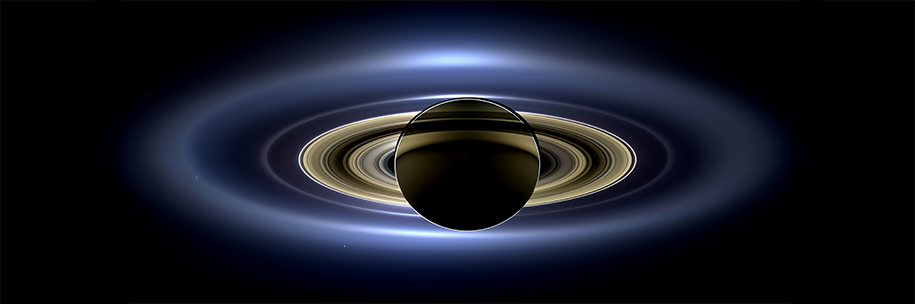
NASA’s Cassini space probe orbited Saturn for 13 years, when, with its mission complete, it entered a controlled descent, burning up in the ringed planet’s atmosphere. Before its fiery demise, however, Cassini took 1,690 samples of cosmic debris, measuring their chemical composition with its onboard Cosmic Dust Analyzer. Researchers are still studying the data, and a new study published in The Planetary Science Journal is shedding light on Saturn’s most famous feature: its majestic rings.
Viewed from the side, Saturn’s rings appear razor-thin relative to its immense size, kind of like a wide-bored compact disc (remember those?). But this most recent study indicates they’re quite a bit thicker than previously thought.
Read more: “When Earth Had Rings”
Within the cosmic dust samples collected by Cassini, scientists discovered particles with the same chemical composition as the rings (mostly magnesium and calcium), but located as far as three Saturnian radii (112,000 miles) above and below the plane of the rings. In other words, there are particles from Saturn’s rings floating in a wide band around the planet, invisible to a telescope.
How did they get there? One theory is that they were pulled in by Saturn’s gravity, a scenario researchers said was unlikely since they didn’t match the chemical makeup of dust found farther out in the Saturnian system. Instead, scientists believe they were propelled outward from the rings themselves by micrometeoroid strikes. Micrometeoroids are quite common in space, and a series of simulations performed by researchers confirmed this scenario as the most likely reason for the particle dispersal pattern.
As scientists continue to study Cassini’s data, we’ll learn more about Saturn’s rings—and not a moment too soon. Other data collected by the late space probe indicates the rings may be gone in a scant 300 million years. 
Enjoying Nautilus? Subscribe to our free newsletter.
Lead image: NASA/JPL/Space Science Institute