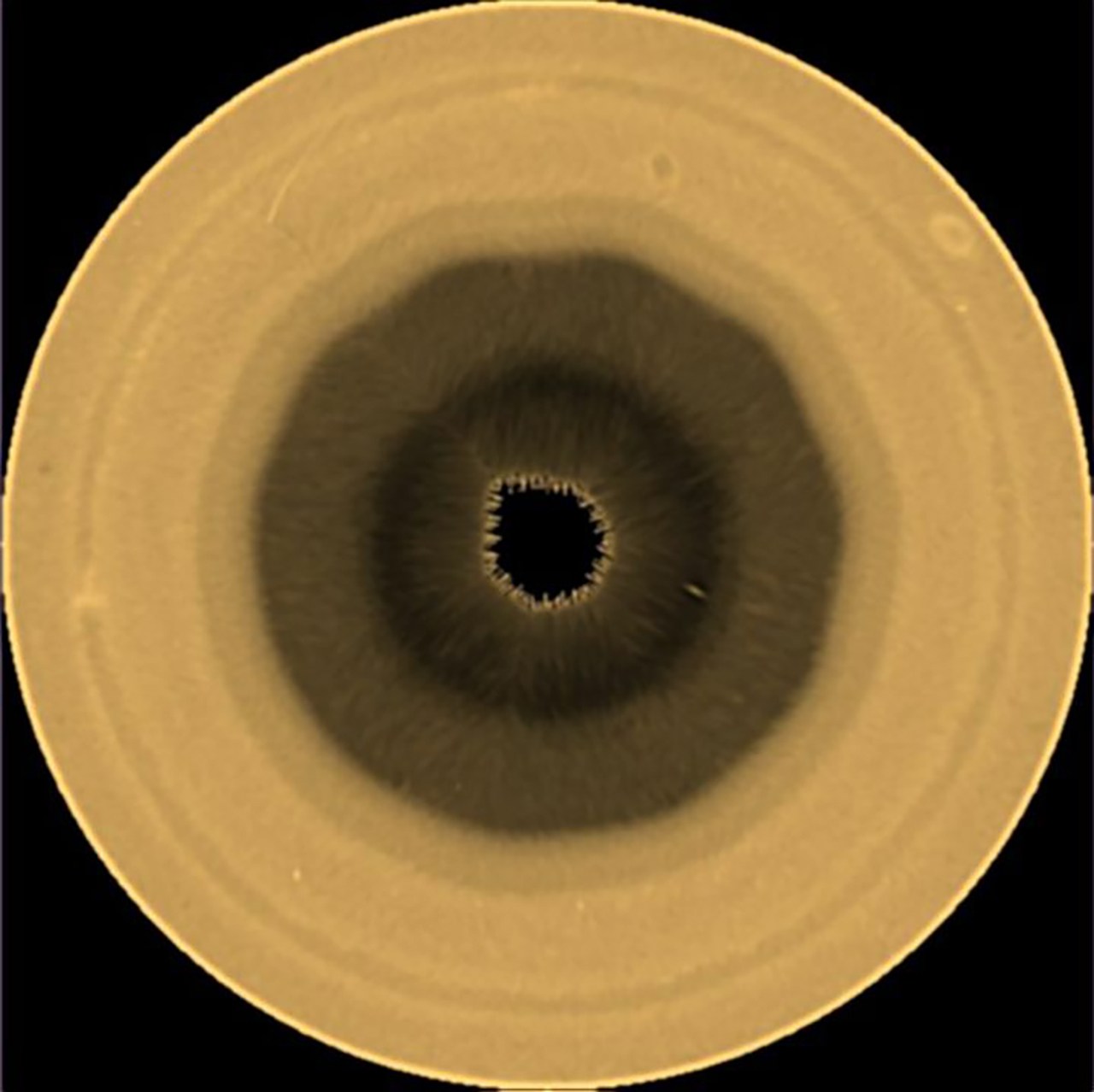
It’s billions of years in the future, but at some point, our warm, friendly sun exhausts its fuel and eventually collapses into a white dwarf. It’s a common fate for stars that aren’t massive enough to become black holes or neutron stars. Using an X-Ray telescope orbiting the Earth, researchers were able to take a peek into the heart of a unique “vampire” white dwarf system (EX Hydrae) for the first time, publishing their findings recently in the The Astrophysical Journal.
White dwarfs are incredibly dense—they have the mass of the sun collapsed into a space about the size of Earth—and their gravitational tugs are monstrous. When a white dwarf orbiting another star siphons off matter from the “donor star,” the binary star system is known as a “cataclysmic variable.”
In addition to their strong gravitational tide, some white dwarfs also have a magnetic pull. In a cataclysmic variable whose white dwarf has a strong enough magnetic field, it can become what’s called an “intermediate polar.” In this situation, in addition to pulling in matter around the white dwarf, it will also pull matter onto its magnetic poles, perpendicular to the accretion disc. Such is the case in the vampire binary star system EX Hydrae.
Read more: “The Stars Foretell Our Doom”
“If you were able to stand somewhat close to the white dwarf's pole, you would see a column of gas stretching 2,000 miles into the sky, and then fanning outward,” study co-author Massachusetts Institute of Technology postdoc Sean Gunderson said in a statement. That 2,000-mile-high fountain of white-hot stellar material was larger than researchers previously thought—around half the radius of the white dwarf itself. Because the jettisoned material is so hot—with temperatures reaching into the millions of degrees Fahrenheit range—the curtain of searing star matter emits x-rays. By measuring these x-rays, researchers were able to get a better idea of how star systems like EX Hydrae work.
Going forward the team plans to study other vampire white dwarfs, and their research could help us measure the size of the universe. “There comes a point where so much material is falling onto the white dwarf from a companion star that the white dwarf can't hold it anymore, the whole thing collapses and produces a type of supernova that's observable throughout the universe, which can be used to figure out the size of the universe,” MIT astrophysicist and co-author Herman Marshall said.
This peek into the bizarre heart of a dying star could turn out to shed light on the nature and scale of everything. 
Enjoying Nautilus? Subscribe to our free newsletter.
Lead image: NASA/CXC/M.Weiss