Keep an eye on the sky in the wee hours of August 13: We’re due for the peak of the Perseid meteor shower. In this annual spectacle, considered by space nerds to be the primo shooting star show, our planet whizzes into the dusty remnants left by the comet 109P/Swift-Tuttle.
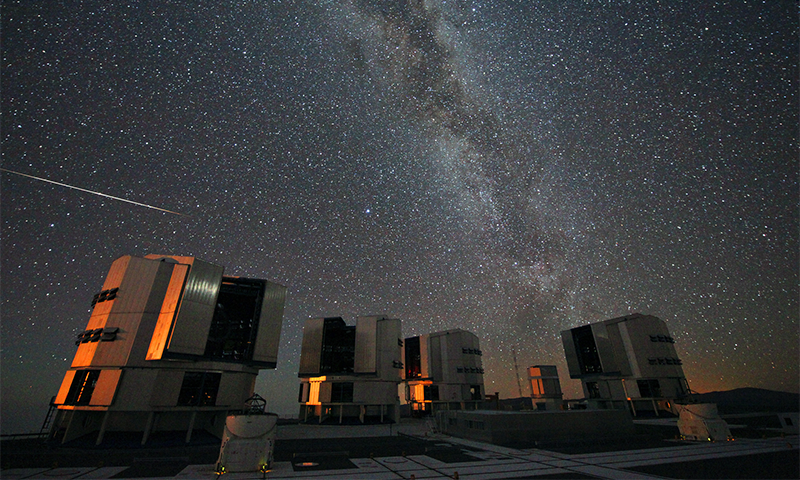
This orbital confluence sets off a cosmic traffic jam. The tiny pieces of Swift-Tuttle, usually no bigger than a grain of sand, smash into Earth’s atmosphere at up to 37 miles per second and burn up, birthing what we know as shooting stars, as seen in this 2010 photo of the European Southern Observatory’s Very Large Telescope in Chile. Each year, the comet dust collides with our atmosphere between mid-July and late August. During the peak of this event, you can spot up to some 100 meteors per hour—if you’re lucky.
The shower’s name, Perseid, is misleading: It’s borrowed from the far-off constellation Perseus, named after the Medusa-killing Greek legend, because the meteors look like they’re emerging from that point. But the streaks we see are usually just 60 miles from the Earth’s surface, rather than more than 200 million light-years away.
If you’re game to go late-night meteor hunting, you might catch the maximum activity at around 3 to 4 a.m. Eastern, on August 13. Although plenty of specs will be burning through the atmosphere the night of August 12—and if you're in the Southern Hemisphere, peak viewing is a night earlier. This year, the peak is slated for a few days after a full moon, so it’s possible that the lunar light obscures the shower. But you can get creative: Try to shield the moon’s glow by standing in a shadow, as suggested by EarthSky. 
Lead image: ESO/S. Guisard