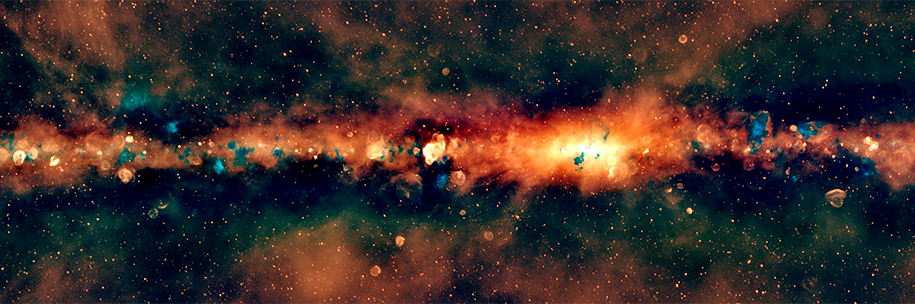
The sheer magnitude of our galaxy, the Milky Way, is difficult for the human mind to fully grasp. Its 105,700 light-year width also makes it just about as difficult to capture with a camera. But recently, researchers from the International Centre for Radio Astronomy Research achieved an important milestone in this gigantic effort.
The team, led by doctoral student Silvia Mantovanini, collected images of the southern sky taken by the Murchison Widefield Array telescope in Australia over 141 nights spanning seven years. Rather than relying on visible light, which can be blocked by clouds of gas and dust, they recorded images using low-frequency radio waves capable of illuminating all manner of cosmic phenomena.
Each image captured a section of the sky sliced into 20 different radio wavelengths with a corresponding color—red for longer wavelengths, blue for shorter. Then, with the help of roughly 1 million computing hours, they stacked the images and connected them together into one giant cosmic portrait. The results are stunning, and you can explore a zoomable version of their finished product here.
Read more: “Can Dark Energy Kill Galaxies?”
The image shows a radiant edge-on perspective of the Milky Way, rippling with stellar activity. It also offers a glimpse into our galaxy’s distant past. “You can clearly identify remnants of exploded stars, represented by large red circles,” Mantovanini said in a statement. “The smaller blue regions indicate stellar nurseries where new stars are actively forming.”
Capturing some 60,000 light-years, it’s the largest low-frequency radio color image of the Milky Way ever recorded, twice the size and twice the resolution of the next largest, which was compiled in 2019. It will remain the most detailed view of the Milky Way until the new largest low-frequency radio telescope array—the Square Kilometre Array Observatory—completes its survey in the next decade.
Until then, this cosmic masterpiece will offer researchers plenty of data to dig into as they explore the place in the cosmos we call home. 
Enjoying Nautilus? Subscribe to our free newsletter.
Lead image: Silvia Mantovanini and the GLEAM-X Team