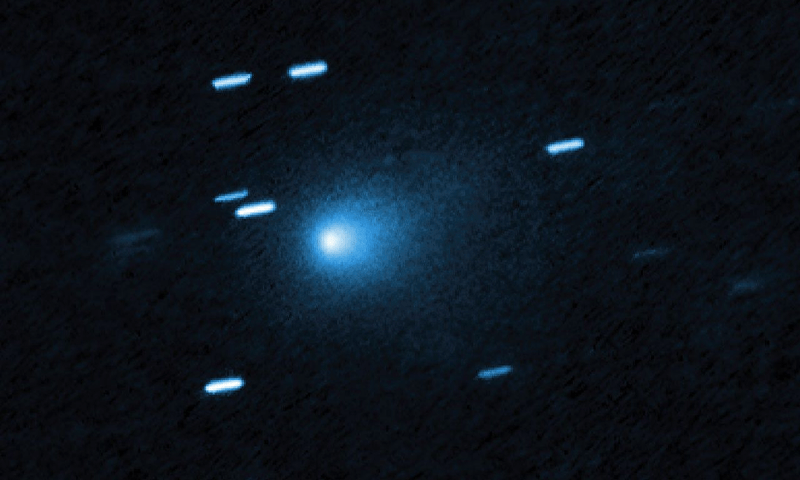
Soon, scientists could take an unprecedented peek at a celebrity visitor from another solar system—the comet 3I/ATLAS. This interstellar sojourner has attracted plenty of fanfare since it was first spotted in July. Soon, a NASA space probe may whizz through parts of the comet’s tail.
This chance meeting could make space history, offering the first sample of an interstellar object—filling a crucial cosmic gap. "We have virtually no data on the interior of interstellar comets and the star systems that formed them," Samuel Grant, a postdoctoral researcher at the Finnish Meteorological Institute, told Space.com.
Grant crunched the numbers and estimated that NASA’s Europa Clipper “will potentially be immersed” in the comet’s ion tail between October 30 and November 6, according to a recently published pre-print article that has not yet received peer review. Comets act as “act as time capsules,” Grant said, holding onto material from their births billions of years ago—and so many light-years away.
So far, it has been difficult to obtain such a sample because interstellar objects like 3I/ATLAS are rarely observed. It’s only the third to be discovered by scientists, in addition to ‘Oumuamua and 2I/Borisov, all findings from within the past decade. But we may encounter more in the coming years: Astronomers think that at least dozens of interstellar objects may always be passing through our solar system, and around eight might be taking permanent residence.
Sampling 3I/ATLAS could be quite the doozy. The Europa Clipper, which is on its way toward its namesake, one of Jupiter’s 95 moons, has some tools that could do the job. But it may face some headwinds. Specifically from the sun: The intense solar winds carrying ions from the comet’s tail may not flow toward the probe, for instance, and it may be hard to differentiate them from ions originating in the sun. There’s also the ongoing U.S. government shutdown, which may prevent scientists from turning on the probe’s instruments needed for this sampling at the crucial moment.
Grant and co-author Geraint H. Jones, a project scientist at the European Space Agency, aren’t part of the Europa Clipper team—so it’s not up to them whether the probe takes advantage of this timing. But their computer code program used to predict this cosmic coincidence, called Tailcatcher, could be used to pinpoint future sampling opportunities. And in 2029, the European Space Agency will kick off the Comet Interceptor mission, which will prioritize these illuminating encounters. 
Lead image: NASA, ESA, David Jewitt (UCLA); Image Processing: Joseph DePasquale (STScI)