Interstellar dust tends to be very, very small. Take your average dust mote floating in a ray of sunlight here on Earth and shrink it down to about 1,000th of its size, then you have a typical grain of space dust. So scientists have long wondered how such small things could ever accumulate into something so large as a pebble, let alone an entire rocky planet.
In fact, models have pointed to something known as the “meter-size barrier” as a hurdle to creating a planet from accreting cosmic dust. Researchers have long considered this barrier because dust amalgamations, as they grow, are at a near constant risk of being smashed into smaller bits or getting pulled into their newly forming star.
But in the constellation of Taurus, just 450 light-years from Earth, swirling disks of protoplanetary material are revealing how this long-standing barrier problem might be solved. A new study, published simply under the title “FAUST” (short for: Fifty AU STudy of the chemistry in the disk-envelope systems of Solar-like protostars) in Astronomy & Astrophysics suggests the answer, my friend, is blowing in the wind.
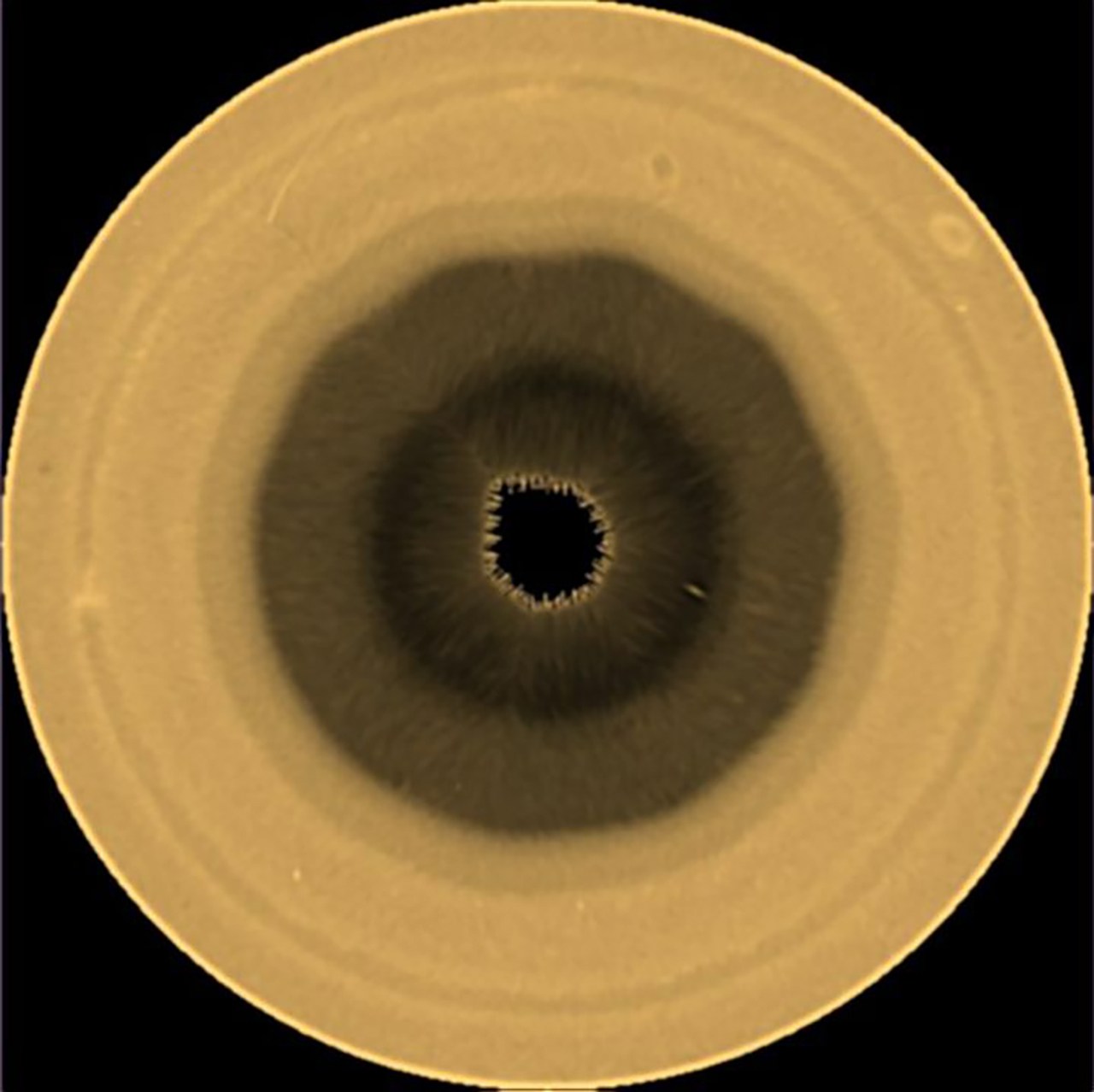
Using a cluster of high-powered telescopes in Chile called the Atacama Large Millimeter/submillimeter Array, scientists have tracked hefty—1-millimeter-sized—clumps of dust being swept out of the crowded center of this binary star system by cosmic winds and to the calmer outer edges. (When stars are forming, as they are here, they spew gas and other particles outward, creating what is known as protostellar winds.) There, away from the new stars’ gravity and violent maelstrom of other dust particles, those fortunate particles have the chance to grow, gathering more material, before migrating back, bigger and stronger, having crossed the meter-size barrier.
These observations “bring us closer to understanding our cosmic origins,” Claire Chandler, a scientist with the National Science Foundation’s National Radio Astronomy Observatory and collaborator in the new research, said in a statement. And show how even some of the smallest cosmic specs might ride to temporary safety on a gust of wind. 
Lead image: B. Saxton U.S. National Science Foundation/NSF National Radio Astronomy Observatory