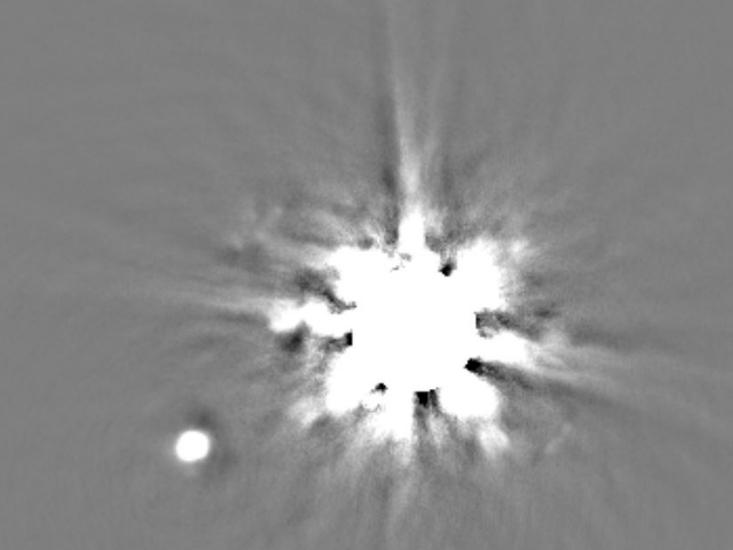
As astronomers point their telescopes up at the sky to learn about the cosmos, they tend to push those devices’ abilities to their limits. The edge of what we can measure is, of course, where all the interesting things are happening. The downside of this ambition is that the conclusions drawn from the newest data are often a bit skewed. This may be most apparent in the hunt for exoplanets. It is, according to Geneva University’s Alexandre Santerne, like a “crime investigation, but with observation instead of DNA and planet instead of dead body.”
In May, a team of scientists at the Very Large Telescope in Chile uncovered an impostor planet. A Jupiter-like planet discovered in 2010 by NASA’s Kepler mission orbiting star HD 8049 turned out to be no such thing: Instead, it’s a white dwarf, an old star in the end stage of its life. So, how can a decaying star masquerade as a planet for several years?
When Kepler detects potential planets, it looks for tiny dips in the target star’s light, when a planet crosses, or “transits” across its face. In this type of analysis, a white dwarf can look a lot like a giant planet. We think of stars as huge in comparison to planets, but white dwarves are much smaller than typical stars; the one orbiting HD 8049 is about the same size as Jupiter. Also, this particular white dwarf emits practically no light in the part of the spectrum that Kepler looks in. An object the size of Jupiter that doesn’t give off any light is something that Kepler flags as an exoplanet.
So what gave it away as a star? A detailed analysis done by the team at the VLT found that the planet’s spectrum—the radiation it emitted—was consistent with the hot and dense atmosphere of a white dwarf. What they were looking at was not a planet in orbit: It was a binary star system, where the white dwarf transits in front of HD 8049, the bigger and brighter star.
The VLT’s analysis also explained why the white dwarf ended up looking so much like a planet. HD 8049 is very bright, like a young star of about 100 to 400 million years old. But by looking at its spectrum, the VLT saw that it has no lithium left, suggesting that it consumed all of that element, meaning that it’s about 500 million years old. Apparently, it has sucked some of the mass from its companion white dwarf, which gave it extra fuel to burn, making it hotter and brighter than other stars its age. This made the white dwarf less massive, and consequently darker.
Quite a double act: a star that makes itself look younger by stealing mass from another, thus making the other look more like a planet.
This isn’t the only time a “planet” has been unmasked as something else entirely. In June, the very existence of a potential planet orbiting the nearby star Alpha Centauri B came under question. Astronomers at HARPS, an on-the-ground telescope based in Chile, first spotted the alleged planet in 2010. But a German astronomer said it kept disappearing from his data depending on the kind of analysis he was running.
These discoveries should be taken with a pinch of salt—ground-based telescopes used for hunting exoplanets can’t spot the tiny light dips as well as the in-space ones. In fact, it’s thought that ground-based telescopes like the Transatlantic Exoplanet Survey have such a high false positive rate that most of the planets they find may be false ones; Ken Rice at the Royal Observatory in Edinburgh says it’s probably 90 percent. Kepler, with the advantage of being outside Earth’s atmosphere, has a lower false-positive rate that astronomers estimate at 5–10 percent.
So how can we stop cosmic impostors sneaking their way into theories of exoplanetary behavior and evolution? NASA has commissioned Kepler’s successor: the Transiting Exoplanet Survey Satellite (TESS), which will use the same type of equipment as Kepler, but will survey more stars and focus only on the brightest ones, meaning it should be harder to fool. High contrasts make planets moving across stars easier to pick out, and focusing on these stars will make it easier to accurately identify smaller, Earth-like planets.
Our obsession with discovering these exoplanets will always be restricted by the limitations of our observational power. How can we really account for stars like HD 8049 and its white dwarf companion?
It all comes back to Santerne’s exoplanetary investigation. The best tools for solving these mysteries are careful observations and a decided skepticism that makes room for uncertainty.
Originally from Scotland, Claire Cameron is an intern with Nautilus and a recent graduate of Columbia Journalism School.